In Jamaican folklore, Bredda Anansi has tricked tigers, rats and his own family. Story six in our Anansi series is the day he tricked a hungry guest out of his supper, and the day that guest, slow and quiet Bredda Turtle, served him the very same dish right back.
New to the series? Start here: Who Is Bredda Anansi? · Previous story: Anansi and the Sticky Man
Proverb
“Anansi rope tie Anansi.”
Play a trick long enough, and one day it catches you.
Yam Inna Di Fire
One evening, Anansi dug the fattest yellow yams from his ground and buried them in the hot coals. By sunset the skins had cracked open, and the whole yard smelled sweet.
He had just sat down with his plate when there came a slow knock at the door.
It was Bredda Turtle. He had walked all day from the river, slow the way Turtle does everything, with dust on his shell and nothing in his belly.
“Evenin’, Bredda Anansi. Mi smell yuh yam from all di way down di road. Mi beg yuh a likkle piece? Mi walk from mawnin’.”
Anansi’s heart sank straight into his slippers. Everybody knows the rule: when a hungry visitor comes to your door at mealtime, you feed them. Turn Turtle away, and the whole district would hear about it by morning.
So Anansi put on his biggest smile. “Come een, come een, Bredda Turtle. Siddung, man.”
Wash Yuh Hand Dem
Turtle sat down gratefully and reached for a yam.
“Eh-eh!” Anansi slapped the table. “Yuh a go eat wid dem nasty hand? Gwaan down a river go wash dem first.”
Turtle looked at his hands. They were dusty from the road. Fair enough. So off he went, slow, slow, down the path to the river. He washed his hands clean and walked all the way back.
By the time he sat down, half the yams were gone.
Turtle reached again.
“Look pon yuh hand dem!” Anansi said, shaking his head. “Dutty again! Mi cyaan have dat at mi table.”
Turtle looked down. It was true. Turtle walks on his hands as well as his feet, and the dusty path had covered them all over again. So back he went to the river, slower than ever, and this time he tried to walk on the grass beside the path.
When he finally got back, the plate was empty. Anansi was leaning back in his chair, licking his fingers.
“Ah, Bredda Turtle, yuh tek so long, mi did think yuh nah come back. Shame. Di yam dem did sweet bad.”
Turtle said nothing. He just nodded, slowly, the way Turtle does everything.
“Tenk yuh fi yuh hospitality, Bredda Anansi. When yuh pass by di river one day, come eat wid mi. Mi will cook somet’ing nice.”
Dinner Under Di River
Now, Anansi has never turned down free food in his life. So a few days later, he strolled down to the riverbank at dinnertime.
Turtle lived at the bottom of the deep pool under the big rock. When Anansi called, Turtle’s head popped up through the water.
“Come, Bredda Anansi. Di table set.”
Anansi looked down through the clear water and his mouth fell open. On the riverbed sat a table piled high: river fish, fat janga, roasted plantain, all laid out and waiting.
He dived straight in.
And he floated straight back up.
Anansi was too small and too light. He bobbed on top of the water like a cork. He tried again. Up he came. He tried a third time, kicking hard. Up again.
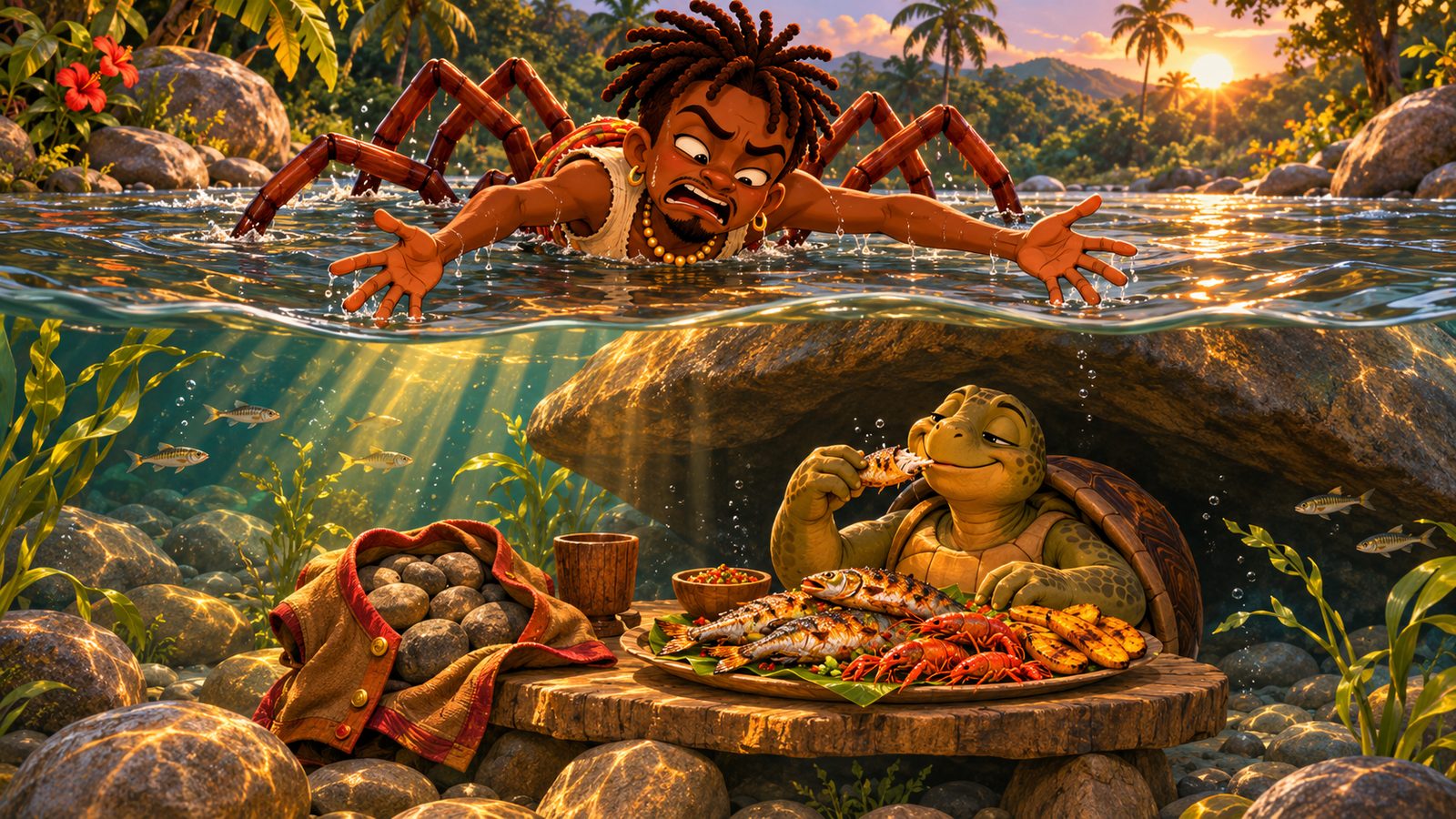
Then he had an idea. He climbed out, filled every pocket of his jacket with heavy river stones, and jumped back in. This time he sank, down, down, down, all the way to Turtle’s table.
No Jacket At Di Table
Anansi pulled up a chair and reached for the biggest fish.
Turtle cleared his throat.
“Eh-eh, Bredda Anansi. Inna my house, nobody wear dem jacket at di table. Tek it off, please.”
Anansi froze with his hand halfway to the plate.
Everybody knows you follow the manners of the house you visit, even when you don’t like them. And Anansi, of all people, couldn’t argue about table manners. Not after what he did with the hands.
Slowly, he unbuttoned his jacket. Slowly, he slipped it off.
WHOOSH.
Without the stones, Anansi shot straight up through the water and popped out on the surface of the river.
And there he floated, hungry and dripping, looking down through the clear water as Bredda Turtle sat at his table and ate, slowly, every last fish and every last janga.
Jack Mandora, me no choose none.
So Why Do We Still Tell This One?
Look at what Anansi used as his weapon: manners. “Wash your hands” sounds polite. It sounds reasonable. Nobody could call it greed. That’s what made it such a clever trick, and such a mean one.
And look at how Turtle answered. No shouting, no fighting, no running to tell the district. He used manners too. One rule of the house for another. Fair is fair.
That’s why Jamaicans turned this lesson into a proverb with Anansi’s own name in it: Anansi rope tie Anansi. Whatever trick you play, be ready to have it played back on you. Granny would say it when one cousin tricked another out of the last piece of cake and woke up the next day to find his own sweetie gone.
There’s one more lesson, and it’s in Turtle himself. He’s slow, he’s quiet, and he’s easy to underestimate. Anansi certainly did. But Turtle never forgot, and he never rushed. He just waited for his turn.
Storytelling Roots
The tale of Anansi and Turtle comes to us from the Akan peoples of Ghana and is one of the best-known Anansi stories carried across the Atlantic. Like so many of these tales, it was passed from mouth to mouth long before anyone wrote it down. What you’ve just read is Showcase Jamaica’s own retelling, with a Jamaican table set at the bottom of the river.
Cultural Note
Across West Africa and in Jamaican yards, a visitor who arrives at mealtime gets fed. Turning away a hungry guest is a disgrace. Jamaicans even have a proverb for it: “When visitors come a wi fireside, wi mek wi pot smell sweet.” Anansi’s real crime in this story isn’t just greed. It’s breaking the rule of the house while pretending to honour it.
Previous story: Anansi and the Sticky Man · Next story: Anansi and Dry-Head → · All stories: Who Is Bredda Anansi?
Talk Di Tings
Who in your family always found a reason why you couldn’t have a piece? And who finally paid them back?
Drop your stories in the comments, or tag us on Instagram @showcasejamaicamedia.
Walk Good. 🇯🇲
Every Nook. Every Cranny. All Jamaican.