A journey through Jamaican music history, from the birth of ska and rocksteady to reggae, dub, digital dancehall and global influence.
Jamaica is a small island. You would never know it by listening to the last seventy years of popular music.
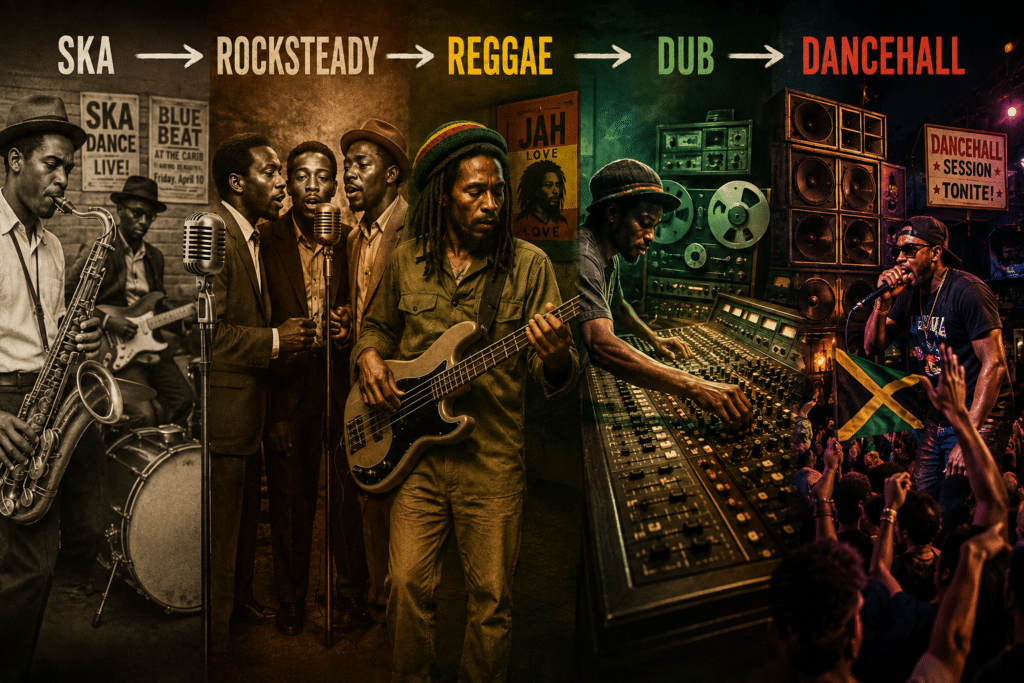
Ska. Rocksteady. Reggae. Dub. Dancehall.
Jamaican music history is a story of repeated reinvention. Jamaica did not give the world one famous musician or one successful genre. Generation after generation, Jamaicans built new sounds, new ways of making music, and new ways of performing it — and every time the music changed, something from the generation before it stayed behind.
The horns and drive of ska slowed into rocksteady. Rocksteady’s heavier bass helped shape reggae. Reggae records were pulled apart in the studio and rebuilt as dub. Sound-system deejays moved from talking over instrumentals to becoming recording artistes in their own right. Dancehall carried all of it into the digital age.
The history of Jamaican music is not a clean handoff where one genre ends and the next begins.
It is a story of constant reinvention — and to understand how one Caribbean island became one of the most influential musical centres on earth, you have to start before reggae was reggae.
Quick answer: What is the history of Jamaican music? Modern Jamaican popular music developed through five major eras — ska, rocksteady, reggae, dub and dancehall — with each one building on what came before rather than replacing it. Ska’s offbeat energy slowed into rocksteady, rocksteady’s heavy bass shaped reggae, reggae recordings were rebuilt in the studio as dub, and sound-system deejays eventually became the artistes fronting dancehall. Every era still lives inside the next.
Jamaican Music Timeline
| Era | Approx. Emergence | What Changed |
|---|---|---|
| Ska | Late 1950s–early 1960s | Fast tempo, offbeat skank, prominent horns |
| Rocksteady | Mid-1960s | Slower rhythm, heavier bass, stronger vocal harmonies |
| Reggae | Late 1960s | Distinctive bass-and-drum groove, wider lyrical and spiritual expression |
| Dub | Late 1960s–1970s | Existing recordings remixed through bass, echo, reverb and studio effects |
| Dancehall | Late 1970s onward | Deejay-centred performance, riddim culture and later digital production |
These periods overlap. The dates mark emergence, not the moment an older genre stopped existing.
Before Ska: The Sounds That Laid the Foundation
Long before Bob Marley became a global icon, and long before anyone outside Jamaica had heard the word “reggae,” Jamaicans already had their own musical traditions.
Mento — most popular through the first half of the 20th century — blended African-derived rhythms with European musical structure and Jamaican folk tradition. Kumina and Revival music moved alongside it, part of the same wider island soundscape.
But the road to modern Jamaican popular music also ran straight through what Jamaicans were hearing from overseas.
By the 1950s, American rhythm and blues reached Jamaica through imported records and radio signals bouncing up from the southern United States, and Jamaicans developed a real appetite for it.
There was one problem: not everybody had a radio, and nobody had an unlimited supply of imported vinyl.
That gap built one of the most important institutions in Jamaican music history — the sound system.
Entrepreneurs loaded speakers, amplifiers and turntables onto trucks and threw dances across Kingston, and eventually the whole island. A selector played the records. Someone worked the microphone, hyping the crowd between songs. Rival sound systems competed hard, each one hunting for tunes the other didn’t have.
The sound system became more than a mobile party. It became the place where Jamaican music was tested.
If a tune moved the dance, producers knew they had something. If it emptied the floor, everybody knew that too.
Sound-system culture would go on to shape nearly every major chapter of Jamaican music that followed — ska, reggae, dub and dancehall all owe it something. As the American rhythm and blues records favoured by Jamaican audiences became harder to obtain — and sound-system operators searched for exclusive tunes their rivals could not play — local producers increasingly began recording Jamaican musicians.
Jamaica was ready to find its sound.
Ska: The Sound of a Country Stepping Forward
By the late 1950s and early 1960s, a distinctly Jamaican popular sound had arrived: ska.
Fast, energetic and instantly recognisable by its emphasis on the offbeat, ska pulled together rhythm and blues, jazz and Jamaican tradition into a sound that was unmistakably Jamaican.
Its rise lined up with one of the biggest moments in Jamaica’s history. On August 6, 1962, Jamaica gained independence from Britain — an anniversary the island now marks each year alongside Emancipation as part of Emancipendence. The music didn’t exist because of independence — but it’s hard to separate early ska from the confidence of a country stepping into a new chapter. You can hear that optimism in the recordings themselves.
Artists and musicians including The Skatalites, Prince Buster, Derrick Morgan, Millie Small and Desmond Dekker carried the sound forward, while producers Clement “Sir Coxsone” Dodd and Duke Reid became central figures in Jamaica’s growing recording industry.
What does ska sound like? Listen for the guitar or piano hitting sharply between the main beats — the ska “skank” — layered over a walking bassline, drums, and often a full horn section. It was music built to move to.
But ska was proof of something bigger than a new dance craze. Jamaica was no longer just consuming music made elsewhere. It was becoming a producer of music in its own right.
How Ska Left Jamaica
Migration carried the sound to Britain, where it took root inside Caribbean communities. Years later, British bands revived it through the Two-Tone movement, blending Jamaican ska with punk and new wave. It was an early sign of a pattern that would repeat for decades — Jamaica creates something at home, the world takes notice, and somewhere else an entirely new movement grows out of it.
Back on the island, though, the music was already changing again.
Rocksteady: When Jamaica Slowed the Tempo
Ska ruled for a relatively short stretch before Jamaican musicians began pulling the tempo back. By the mid-1960s, rocksteady had arrived. The pace relaxed. The horns pulled back. The bass moved toward the centre of the mix. Singers finally had room to breathe.
Rocksteady became closely tied to vocal harmony groups — The Paragons, The Techniques and The Heptones flourished, while Alton Ellis became one of the era’s defining voices. Rocksteady’s run was brief, but its fingerprints are all over what came next. Without it, the jump from ska to reggae barely makes sense.
Rocksteady Was More Than a Bridge
It’s tempting to treat rocksteady as a short connector between two more famous genres — that undersells it badly. The heavier basslines, slower rhythms and vocal phrasing developed during this era became foundational to everything that followed, and some of Jamaica’s most enduring songs were cut during this exact window — songs that later generations of reggae and dancehall artists would cover, sample and rebuild.
That habit of looking backward while making something new is one of Jamaican music’s defining traits. An old song returns with a new rhythm. An old rhythm carries brand-new lyrics. A recording from one decade becomes the foundation of a hit in the next.
Jamaican music has always known how to recycle without repeating itself.
By the end of the 1960s, rocksteady was giving way to reggae.
Reggae: The Sound Jamaica Took to the World
For a lot of people outside Jamaica, reggae is Jamaican music history in a single genre. That’s understandable — no Jamaican genre is more internationally recognised, and no Jamaican musician has achieved Bob Marley’s level of global recognition.
But reggae didn’t appear out of nowhere. It grew directly out of the experimentation that came before it.
By the late 1960s, the rhythm changed again — heavier, more distinctive, with bass and drums holding the centre while guitar and keyboard built the patterns that became reggae’s signature.
The genre eventually became so culturally significant that UNESCO inscribed Reggae Music of Jamaica on its Representative List of the Intangible Cultural Heritage of Humanity in 2018, recognising it as a blend of Jamaican, Caribbean, North American and Latin influence — and as a form of social commentary and cultural expression in its own right.
Reggae was never just one sound. Early reggae feels different from the roots reggae that broke internationally through the 1970s. Roots reggae leaned into Rastafari, African identity, inequality, resistance and the daily reality of Jamaican life — carried by artists including Burning Spear, Culture and Black Uhuru.
Then there’s Bob Marley and the Wailers. Peter Tosh. Bunny Wailer. Jimmy Cliff. Toots and the Maytals. Dennis Brown. Gregory Isaacs. Each one brought something different, and reducing reggae to dreadlocks, red-gold-and-green, and a handful of Marley songs misses most of the story.
There’s roots reggae. Lovers rock. Rockers. Dub-influenced reggae. Reggae for dancing and reggae for reflection. Reggae about love, struggle, spirituality, politics and ordinary life. That range is a big part of why the music travelled so well — and it’s exactly what we unpack in Dancehall vs Reggae: What’s the Difference?, if you want to go deeper on how the two genres split apart.
Bob Marley opened a door — he was never the whole room. You can’t tell reggae’s global story without him. But the island’s music industry was packed with singers, musicians, producers and sound-system operators constantly pushing what the music could become — and some of the most important innovation was happening behind the mixing board.
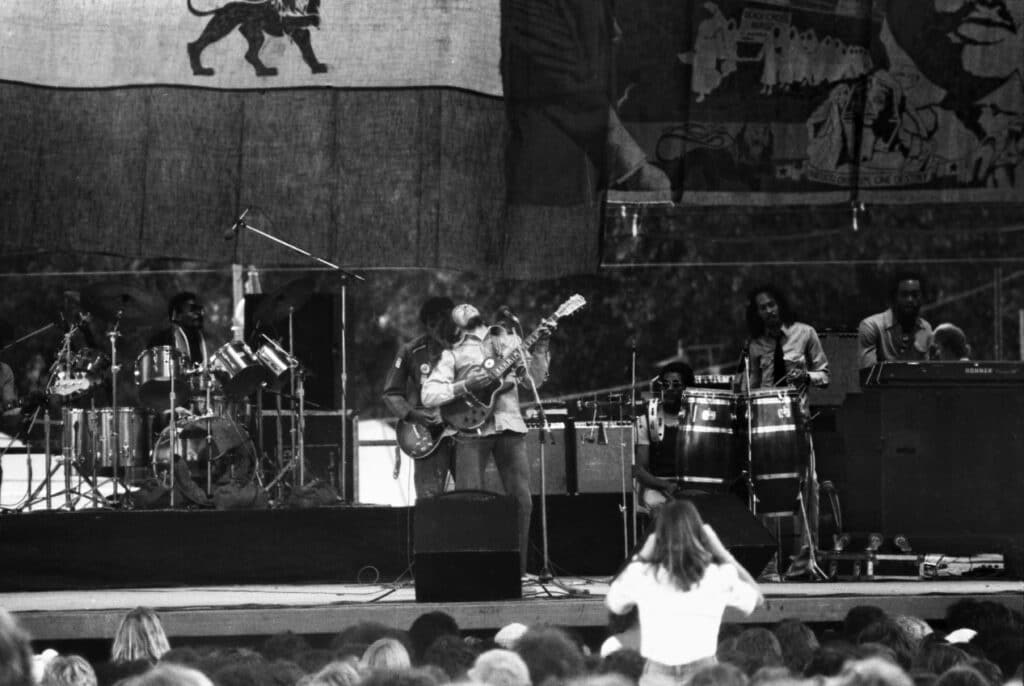
That’s where dub comes in.
Dub: When the Studio Became an Instrument
Picture a finished reggae recording getting pulled apart. The singer disappears. The bass pushes forward. The drums hit harder. A guitar line flickers in for two seconds and vanishes. Vocals echo off into the distance.
The song feels completely different — even though most of the original recording is still buried somewhere inside it.
That’s dub.
Starting around the late 1960s and developing through the ’70s, Jamaican engineers began building instrumental “versions” of existing recordings, closely tied to sound-system culture — a popular vocal tune stripped down and reborn for the dance. Engineers pushed further still, manipulating individual elements with mixing consoles, echo, reverb and studio effects.
The mix itself became the performance.
King Tubby and the Art of Taking Music Apart
Osbourne “King Tubby” Ruddock, working out of Waterhouse in Kingston, became one of the most important figures in dub’s development — treating the finished recording not as something fixed, but as raw material. Lee “Scratch” Perry became another of the island’s great studio innovators, and producers like Scientist carried dub experimentation into new generations.
Dub’s reach goes far past reggae. The idea of remixing a track, pushing the bass forward, and building multiple versions of the same song became foundational to electronic and dance music worldwide. Jamaican dub helped prove that the person behind the mixing board could matter as much as the person in front of the microphone.
But dub was only one innovation growing out of sound-system culture. Another was happening right on the mic.
From Toasting to the Jamaican Deejay
Quick language note: in Jamaica, the person playing the records is the selector. The deejay is the one on the mic. That trips up international audiences, because everywhere else “DJ” usually means the person spinning the tunes.
In Jamaican sound-system culture, deejays built their own style — talking, chanting and rhyming over instrumentals. That practice became known as toasting, and artists like U-Roy turned it from a live sound-system habit into commercially successful recorded music.
The voice stopped just introducing the next song. The deejay became the song — one of the clearest bridges between reggae and what would eventually become dancehall.
Dancehall: A New Generation Takes Over
By the late 1970s and into the ’80s, the next chapter of Jamaican music history was taking shape.
Dancehall grew out of the same sound-system spaces that nurtured every genre before it, but it spoke for a new generation. Production got more stripped down. The deejay moved to centre stage. And where roots reggae often looked toward spirituality and resistance, dancehall stayed immediate — the party, the community, fashion, relationships, competition, politics, humour, survival. Whatever Jamaicans were talking about found its way into the dancehall.
That’s part of why the genre has always drawn both loyalty and controversy. Dancehall doesn’t always present the version of Jamaica people want packaged for export. Sometimes it presents Jamaica exactly as one artist sees it.
Early Dancehall and the Rise of the Deejay
Yellowman, Josey Wales and Eek-A-Mouse became major names in this era. An aspiring deejay didn’t need a record deal to start — he built a name in the dance, won over a crowd, developed a flow, moved between sounds, and then maybe walked into a studio. The dancehall itself was the testing ground, just like it had been for generations before.
Sleng Teng and the Digital Revolution
In 1985, Wayne Smith’s Under Mi Sleng Teng, produced by King Jammy, became a landmark — its electronic riddim signalling a new digital era for dancehall. There’s debate over exactly which recording deserves the title of “first” digital riddim, but Sleng Teng’s cultural impact isn’t in question. Producers no longer needed a full studio band to build a rhythm. Records became faster and cheaper to produce. New producers entered the industry, more riddims got built, and dancehall’s sound accelerated into a new era.
By the late ’80s and ’90s, Shabba Ranks, Super Cat, Buju Banton, Beenie Man and Bounty Killer carried dancehall into new spaces at home and abroad. Sean Paul became one of its biggest crossover successes. Vybz Kartel, Mavado, Spice, Popcaan and others have since shaped different eras of modern dancehall — and pulled global audiences along with them.
To understand how all of it actually works, though, you need to understand one more idea Jamaican producers transformed into a distinctive musical system: the riddim.
What Is a Riddim in Jamaican Music?
In most of the international music industry, one instrumental track belongs to one song. Riddim music in Jamaica has never worked that way.
A producer builds one instrumental — the riddim — and multiple artists record completely different songs over it. One riddim might carry a handful of songs. Another might carry dozens, and some come back years later for a whole new generation of artists.
The practice runs back through reggae and sound-system culture, and it became central to dancehall. It turns every riddim into a musical conversation: one artist records a love song over it, another a clash tune, another turns it into the biggest party record of the year. The riddim stays. Everything around it changes.
That’s why trying to understand Jamaican music by looking only at individual artists misses half the story. You have to understand the producers, the studios, the sound systems, the selectors, the deejays — and the riddims moving between all of them.
The Sound System: The Thread Connecting It All
Follow Jamaican music history from the 1950s to today and one institution keeps showing up: the sound system.
Before Jamaica’s recording industry was fully established, sound systems helped create demand for new music. Once producers started recording, sound systems decided which songs actually became popular. When instrumental versions appeared, sound systems gave dub room to grow. When deejays started toasting, the sound system gave them a stage. When dancehall emerged, the sound system stayed one of its most important proving grounds. And when Jamaican music travelled overseas, sound-system culture travelled right along with it.
Sound systems built their own competitive culture too — biggest speakers, newest tunes, exclusive recordings, sharpest selector, strongest deejays, and when two sounds clashed, the drive to beat the other one outright. That culture became the sound clash tradition that’s still part of Jamaican music today.
The technology keeps changing — vinyl to CDs, CDs to laptops, music going fully digital — but the mission has stayed the same: play the right tune at the right moment and move the crowd.
How Jamaican Music Changed the World
The easiest way to measure Jamaica’s influence is to count the genres the island created: mento, ska, rocksteady, reggae, dub, dancehall. That alone would be an extraordinary legacy for any country. But Jamaica’s reach gets bigger still once you follow those sounds past the island’s shoreline.
Jamaican Sound-System Culture and Hip-Hop
The relationship between Jamaica and hip-hop is real but shouldn’t be oversimplified into “Jamaica invented hip-hop.” Hip-hop grew out of a specific mix of African American, Caribbean and Latino experience in New York — but Jamaican sound-system culture is unmistakably part of that story. DJ Kool Herc, born Clive Campbell in Kingston, brought sound-system instincts into the Bronx scene where early hip-hop took shape: powerful sound systems, a DJ controlling the music, MCs on the mic, competition, and community gatherings built around recorded sound. Jamaican influence was one ingredient in something new — and hip-hop later fed back into Jamaican dancehall in return. The musical conversation never ran in only one direction.
Ska Finds Another Home in Britain
Jamaican migration helped plant ska and reggae inside British popular culture, and the Two-Tone movement later introduced Jamaican ska influence to a new generation through bands like The Specials, The Selecter and Madness. The sound changed as it travelled — but its roots stayed audible.
How Dub Changed the Role of the Producer
Dub’s fingerprints are all over electronic music, remix culture, drum and bass, and other bass-heavy genres. Breaking a recording apart and rebuilding it at the mixing desk is standard practice now. When Jamaican engineers were doing it decades ago, it was radical.
Dancehall Goes Global
Dancehall’s rhythms and vocal patterns have moved through hip-hop, pop, and Caribbean and Latin music. Jamaican artists have collaborated with some of the biggest names in the world, and dancehall-flavoured production shows up on international hits constantly — sometimes obviously, sometimes so absorbed into another genre that listeners never trace it back to Jamaica. Old riddims never really retire, either — songs recorded decades ago are still sampled, rebuilt and introduced to new generations of listeners. That’s both the power and, occasionally, the quiet frustration of Jamaican musical influence: the world has borrowed so often that some Jamaican innovations no longer sound foreign. They just sound like modern music.
Jamaican Music Never Stopped Evolving
It would be easy to end this story with dancehall. Ska became rocksteady. Rocksteady became reggae. Reggae produced dub. The deejay rose. Dancehall arrived. End of story.
Except that’s not how Jamaican music history actually works.
Ska didn’t disappear when rocksteady showed up. Rocksteady didn’t vanish when reggae took over. Reggae kept evolving after dancehall emerged. Dub never really left. Old riddims still get revived. Songs cut decades ago still get sampled. A new artist can take something Jamaicans have heard for generations and find a completely different way to ride it.
That’s the real thread connecting Jamaican music across the decades — not replacement. Reinvention.
Every generation takes something from the one before it, changes the tempo, changes the technology, changes the language, and sends it back out into the world. For an island of Jamaica’s size, that’s a remarkable musical output. But the bigger achievement isn’t the number of genres Jamaica created — it’s the number of ideas Jamaica gave to music: the sound system, the riddim, the version, the dub mix, the deejay on the microphone, the producer rebuilding a song from behind the board, the idea that one piece of music can be used again and again without ever becoming exactly the same thing twice.
From ska to rocksteady, reggae, dub and dancehall, Jamaica has spent decades doing what it does best — taking what exists, making it its own, and making the rest of the world listen.
Quick Questions, Quick Answers
What are the five major eras covered in Jamaican Music History?
This article follows ska, rocksteady, reggae, dub and dancehall. They emerged broadly in that order, although each continued evolving after the next appeared. Earlier forms such as mento, Kumina and Revival helped shape the wider musical environment from which Jamaica’s modern recording industry developed.
What’s the difference between reggae and dancehall?
Reggae and dancehall share the same Jamaican sound-system roots, but they developed different musical conventions. Reggae generally places greater emphasis on sung melodies, bass-led grooves and band-based arrangements, while dancehall places the deejay and riddim more firmly at the centre. Digital production became especially important to dancehall after the mid-1980s, although both genres are far more varied than those basic distinctions suggest. For the full breakdown, see Dancehall vs Reggae: What’s the Difference?
What is a riddim in Jamaican music?
A riddim is a single instrumental track that multiple artists record different songs over — sometimes dozens of songs on one riddim, across different years and even different genres.
Who were the pioneers of dub music?
Osbourne “King Tubby” Ruddock was one of dub’s most important pioneers, alongside innovators such as Lee “Scratch” Perry. Their experiments with instrumental versions, mixing, echo and reverb helped turn the recording studio into a creative instrument.
How did Jamaican music influence hip-hop?
Jamaican-born DJ Kool Herc brought sound-system culture — powerful speakers, a DJ controlling the music, MCs on the mic — into the Bronx scene where early hip-hop developed in the 1970s.
What does “deejay” mean in Jamaican music, and how is it different from a DJ?
In Jamaica, the selector plays the records; the deejay is the one on the microphone, toasting, chanting or rhyming over the riddim. Internationally, “DJ” usually refers to the person playing the music — the opposite role.
Walk Good. 🇯🇲
Every Nook. Every Cranny. All Jamaican
Sources and Further Reading
- UNESCO, Reggae Music of Jamaica — Representative List of the Intangible Cultural Heritage of Humanity, 2018 inscription
- Britannica, DJ Kool Herc — on his Jamaican background and role in early hip-hop history
- Wikipedia, Sleng Teng — on Wayne Smith’s “Under Mi Sleng Teng” and the 1985 digital-dancehall shift
- Wikipedia, Sound system (DJ) — background on Jamaican sound-system culture’s role in shaping ska, rocksteady, reggae and dub