In Jamaican folklore, Bredda Anansi will do anything to avoid work and everything to get free food. Story five in our Anansi series, Anansi and the Sticky Man, is the time he went further than ever: he played dead. And it’s the reason, the old people say, why spiders hide in the rafters to this day.
New to the series? Start here: Who Is Bredda Anansi? · Previous story: Anansi and the Plantains
Proverb
“Chicken merry, hawk deh near.”
When you’re enjoying yourself too much, trouble is closer than you think.
Di Pea Field Ready
That year, Anansi’s family planted a big field of peas behind the house. Crooky and the children weeded it, watered it, and chased the birds off it every morning, and by harvest time the vines were heavy with fat green pods.
Anansi had done none of the work. But he had very big plans for the peas.
The trouble was, Crooky had rules. The peas were for the family, to be picked together and shared out fair and square. And Anansi, as we know, has never liked sharing anything.
So he lay in bed and thought. And by morning, he had a plan so bold that even he was impressed with himself.
Anansi Tek Sick
That day, Anansi took to his bed and started to moan.
“Ohhh, Crooky… mi feel it. Mi time come. Mi nah go see tomorrow.”
Crooky rushed in with a cup of bush tea, but Anansi waved it away weakly.
“Nuh worry wid tea. Listen to mi last wish. When mi dead, nuh bury mi inna no churchyard. Bury mi down inna di pea field, close to di peas. Mi did love dem peas so much. Mek mi rest near dem.”
And with one last long sigh, Anansi closed his eyes and went perfectly still.
The family cried and wailed. Neighbours came. And just as he asked, they dug a shallow grave at the edge of the pea field and laid Bredda Anansi to rest.
Somebody Inna Di Peas
That very night, when the moon was high and the house was asleep, the grave started to move.
Up came one hand. Then another. Then Anansi himself climbed out, shook off the dirt, and went straight into the pea field. He picked a whole bag of the fattest pods, made a little fire, boiled them up with salt, and ate until his belly was tight. Then he climbed back into his grave, pulled the dirt over himself, and slept like a baby.
Next night, same thing. And the night after that.
Before long, the family noticed: half the field was stripped bare.
“Somebody a tief we peas,” said Crooky.
“Is duppy,” whispered the littlest one.
But Anansi’s eldest son wasn’t so sure. He walked out to the grave, looked at the loose dirt, the footprints in the mud, and the little pile of empty pods nearby, and he narrowed his eyes.
“Duppy nuh boil peas,” he said.
Di Man Inna Di Hat
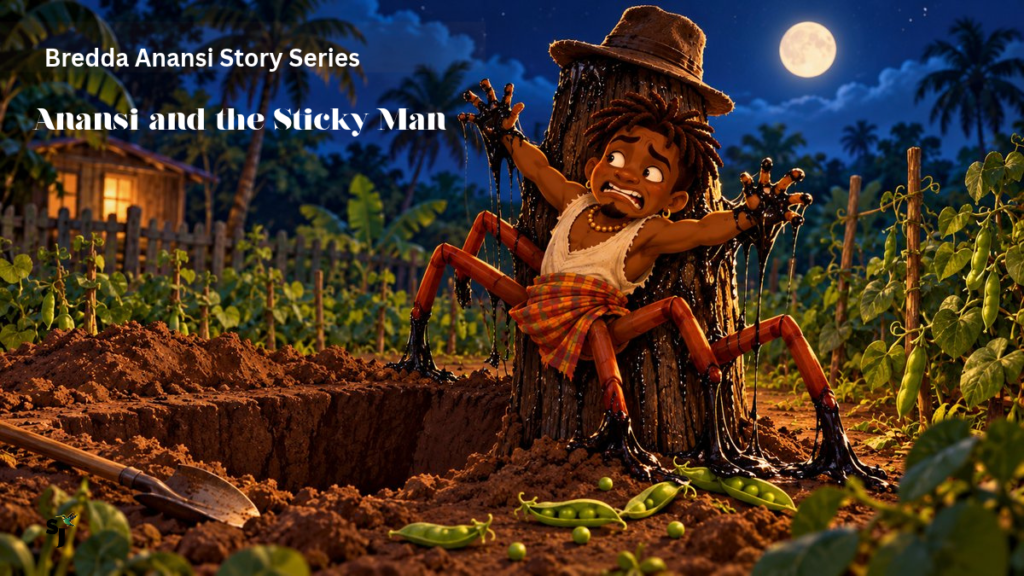
That afternoon, the eldest son went to the bush and dragged back an old tree stump. He set it right at the head of his father’s grave, painted it all over with sticky black tar, and put an old felt hat on top.
In the dark, it looked exactly like a man standing guard.
That night, out came Anansi as usual, dusting himself off and humming, already tasting the peas. He nearly walked straight into the stump.
He jumped back. “Wha’ dis? Who yuh?”
The figure said nothing.
“Mi seh, who yuh? Wha’ yuh a do by mi grave?”
Nothing.
Anansi puffed up his chest. “Yuh nuh hear mi a talk to yuh? Answer mi, or mi box yuh!”
Silence.
So Anansi boxed him. BAP! His right hand stuck fast in the tar.
“Lef’ mi hand! Lef’ it, or mi box yuh wid di other one!”
BAP! Now his left hand was stuck too.
“Oh, so a so it go? Mi will kick yuh!”
He kicked with his right foot, and it stuck. He kicked with his left, and that one stuck too. And there hung Bredda Anansi, stuck hand and foot to a tarred stump in a felt hat, his legs off the ground, at the head of his own grave.
Mawnin’ Come
When the sun came up, the whole family walked out to the pea field. Then came the neighbours. Then, it seemed, half the district.
And there was Anansi, the dead man, very much alive, stuck to a stump with his belly full of their peas.
Nobody said anything for a moment. Then the littlest one started to laugh. Then the neighbours. Then the whole field was bawling with laughter, holding their bellies and pointing.
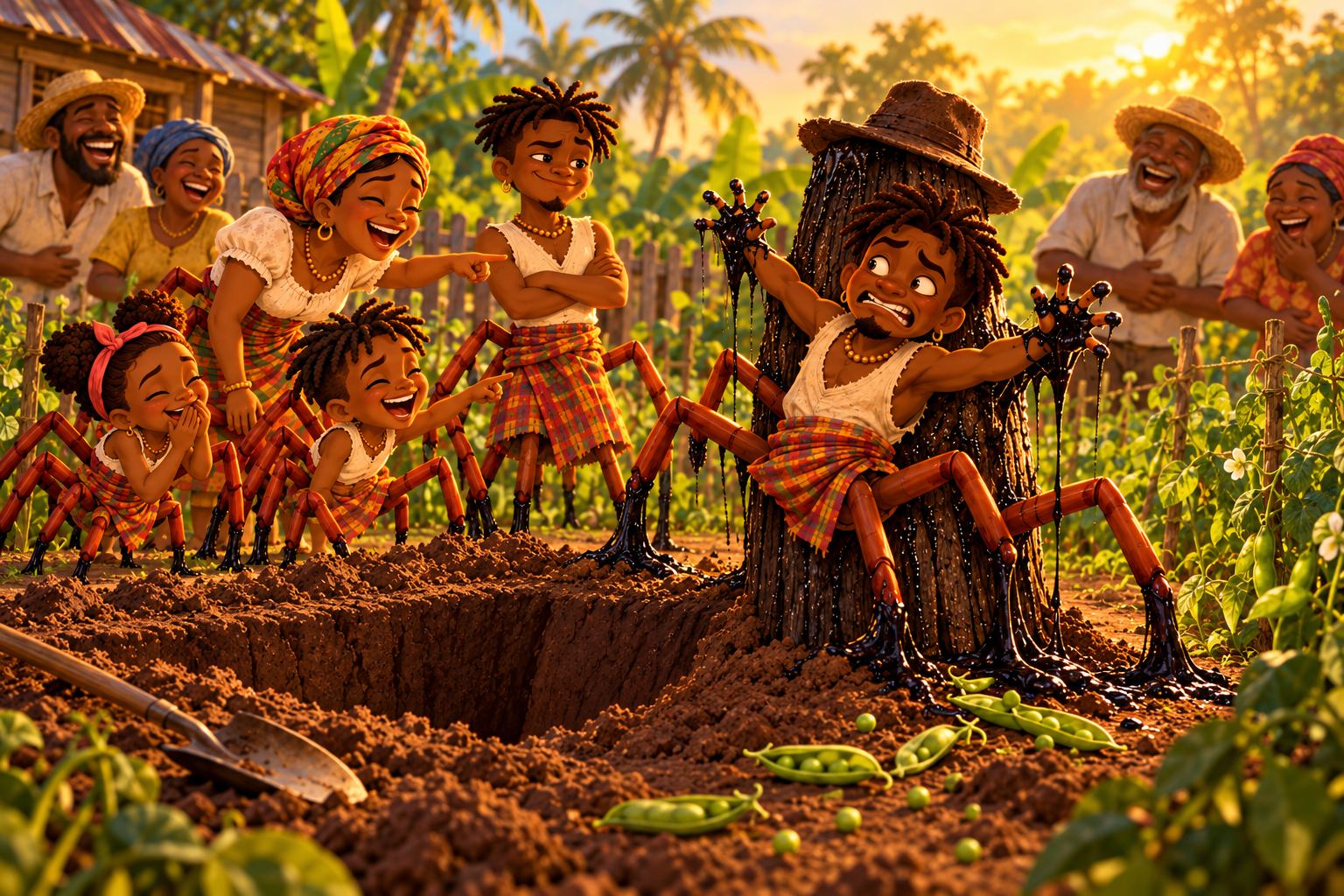
When they finally pulled him loose, Anansi was so ashamed that he couldn’t look anybody in the eye. He ran straight into the house, climbed up the wall, and hid himself in the darkest corner of the rafters.
And he never came down.
That’s why, to this day, you find spiders up in the rafters and the corners of the ceiling, hiding from the shame of the pea field.
Jack Mandora, me no choose none.
So Why Do We Still Tell This One?
Every Jamaican child knows the feeling of getting caught. Hand in the sugar tin, finger in the cake, somebody’s last piece of hard dough bread halfway to your mouth. This story is that moment, stretched to its most ridiculous: a man so committed to dodging work that he’d rather be dead than pick peas with his family.
But the real lesson is in the stump. Anansi didn’t get caught because he was stupid. He got caught because he got comfortable. Night after night it worked, so he stopped looking. Chicken merry, hawk deh near. The moment you’re sure you’ve gotten away with it is the moment to start worrying.
And notice who catches him: not a tiger, not a god, but his own son. The family he kept cheating was the family that finally saw through him.
Granny had a warning for every season: what yuh do inna di dark always come out inna di light. Anansi just found out the hard way, stuck to a stump at sunrise.
Storytelling Roots
Jamaicans have told this tale many ways. Martha Warren Beckwith’s Jamaica Anansi Stories (1924) records three versions. In one, told by Stanley Jones of Claremont, St. Ann, Anansi fakes his death to steal peas, gets stuck to a tarred stump at his own grave, and climbs into the rafters in shame. That is the version retold here. In another, from George Parkes of Mandeville, Anansi tricks a passing goat into getting stuck in his place. What you’ve just read is Showcase Jamaica’s own retelling.
Cultural Note
The sticky-figure trap is one of the most widely travelled folktale motifs, appearing across West Africa, the Caribbean, and the American South, where it became Brer Rabbit’s famous tale. The Jamaican tellings give it their own flavour: a stump in a felt hat at the head of a grave, a pea field, and a spider who would rather play dead than work.
Previous story: Anansi and the Plantains · All stories: Who Is Bredda Anansi?
Talk Di Tings
How did this one end in your yard? Did Anansi run to the rafters, trick somebody else into the trap, or get a licking? And what was the sticky thing made of where you grew up?
Drop your version in the comments, or tag us on Instagram @showcasejamaicamedia.
Walk Good. 🇯🇲
Every Nook. Every Cranny. All Jamaican.