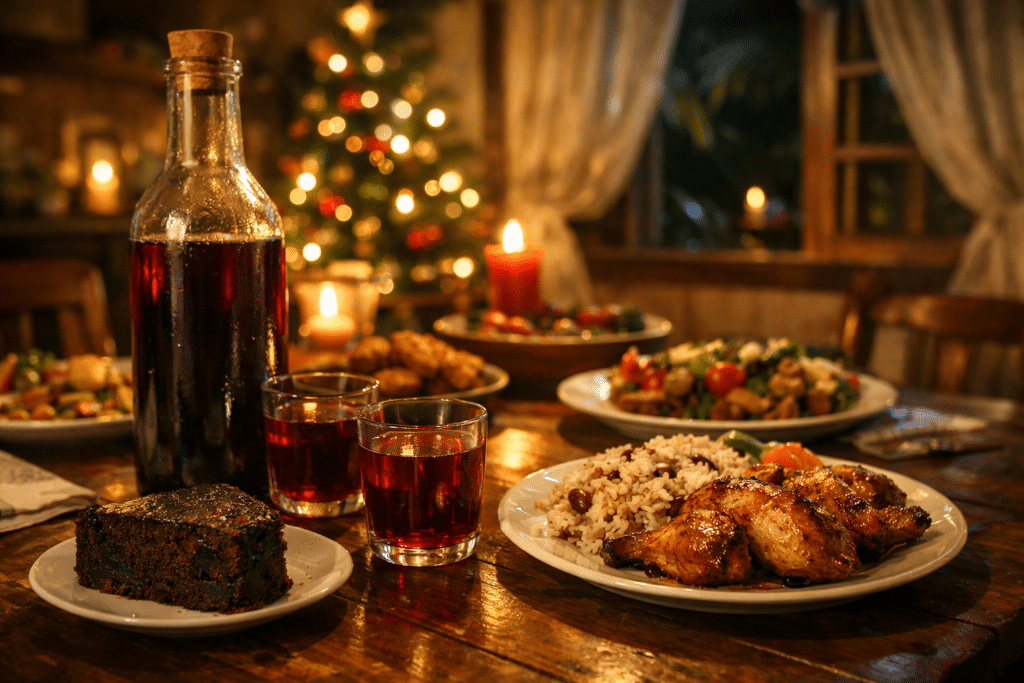
You know Christmas is coming in Jamaica long before anybody puts up a tree. It comes in on the Christmas breeze, that cool little wind that blows in after the rains and makes people pull out a sweater they don’t really need. It comes in the smell of fruit soaking in rum on top of the fridge. It comes the first time somebody says, “Christmas a come, yuh know,” in the tone that means the house is about to get turned over from top to bottom.
Christmas in Jamaica has no snow and no fireplaces. What it has is church, Grand Market, a pot of gungo peas, a glass of sorrel strong enough to make you cough, and a whole family moving through the same few days of December the way they have for generations. Not every household does it the same way, and the season has changed a lot. But anybody who grew up with a yaad Christmas knows the feeling the moment it starts.
This is that Christmas: the build-up, the night before, the morning, the table, and how it travels when you live far from home.
The Build-Up Starts Long Before December
In a lot of Jamaican homes, Christmas really begins with the fruit. Raisins, prunes, currants, cherries and mixed peel go into a big glass jar with rum and wine, and then they sit. Some people start in November. The serious ones start months earlier, and some keep a jar going from one Christmas to the next. That jar is the first sign of the season, and nobody is allowed to touch it.
Then the sorrel shows up. You’ll start seeing it at market from October or November, those deep red bundles at the roadside stall, and smart people buy early. By December the price jumps, because everybody wants it at the same time.
And then there’s the house. Christmas cleaning is not optional. Windows get cleaned and wiped down, ready for the Christmas curtains. The yard gets cut and swept. Some families go further and give the walls a fresh coat of paint, or even a whole new colour. The good plates and glasses come out of the cabinet and get washed, ready to be used over the holidays, especially if family from foreign is coming to stay or visit. Back in the day, board floors got a coat of Genie floor polish and a shine with a coconut brush, and in town the edge of the sidewalk got a fresh coat of whitewash. In the country, it was the stones along the path.
The new curtains, the Christmas bedspread and the comforter usually wait until closer to the day. There’s only so much one house can do at once, and the sorrel still has to be sweetened and the cake still has to be baked.
The shopping builds too: flour, sugar, the ham ordered early, and gungo peas, because Christmas rice and peas is gungo rice and peas in plenty yards. By the week before Christmas, everybody is busy, everybody is tired, and everybody is a little bit excited.
Church Comes First (Granny Will Make Sure)
For many Jamaicans, Christmas still begins in church, and for older family members that isn’t up for discussion. There are Christmas Eve services, and then there’s Christmas morning service, which in most churches starts early, around 6 or 6:30, sometimes a little later depending on how dark it is that morning. The children have been practising their recitations and Christmas songs for weeks. The choir is in full voice. And the congregation is in its Sunday best.
Jamaican Christmas service isn’t stiff. Old hymns sit right beside the carols, one voice always takes the tune a little higher than written, and the message comes back to the same things every year: give thanks, remember why we keep the day, and look out for one another.
Church may not be part of every family’s regular routine anymore, but in plenty homes Christmas Day still moves to its rhythm, and Christmas morning has a way of bringing people back through those doors.
Grand Market Night
If you grew up in Jamaica, Christmas Eve has another name: Grand Market night. In parish capitals and country towns across the island, the main road turns into one long street fair that runs well past midnight. Vendors set up from early. By evening the town is shoulder to shoulder.
Stalls line the road with toys, clothes, shoes, pots and plastic everything. Jerk pans smoke at the corner with chicken and pork, and there are roasted peanuts and sweeties by the bag. It’s also where plenty families buy the new clothes, though those get saved for church on the first Sunday of the New Year. Music comes at you from every direction, a different tune from every stall and shop down the road. Every so often clappaz go off, somebody screams, and then everybody laughs. Clappaz were illegal then and they’re still illegal now, and every Christmas they go off anyway. Children walk around clutching a few dollars they’ve been saving, taking it very seriously, deciding between the starlight and the toy that will break by Boxing Day.
For a lot of Jamaicans, Christmas doesn’t truly start until Grand Market winds down and the night gives way to Christmas morning. If you’re visiting in December, our month-by-month guide covers what the season means for your trip.
Christmas Morning in a Jamaican Yard
Christmas morning starts early, no matter how late Grand Market ran. In a church-going house, it doesn’t matter that you only got in from Grand Market or a party a couple of hours ago. When it’s time for church, you’re getting woken up. Before it’s even light, everybody gets the same instruction: “Go bathe and dress, we have church.” If you’re lucky, you get to taste up your mouth with a little piece of Christmas cake before you leave out for service. Most of the cooking waits until everybody gets home, unless somebody stays behind to start the pots.
After church, the kitchen gets busy. Breakfast and dinner are going at the same time. The ackee was probably boiled from the day before, and it goes into the ackee and saltfish alongside fried dumplings and plantain, maybe some bacon, and a few slices of ham if it’s already done. Meanwhile, some of the dinner pots are already on the stove beside them. Back in the day, there was a fresh loaf of Captain’s hardough bread on the table too. And then there’s the chocolate tea, made from the real chocolate balls, boiled down with nutmeg and a little milk. And boy, was it hot.
With breakfast in your belly, the waiting begins. The dinner smells are all through the house, and nobody is allowed to touch dinner till it’s ready. Children who got a gift that morning are outside showing it to the whole lane. A plate of cake and a glass of sorrel sit ready for anybody who passes through. There’s always a visitor on Christmas Day. Neighbours stop by, family drives in from town, and the phone keeps ringing with calls from abroad.
The day doesn’t run on a timetable. Dinner happens when dinner is ready, usually somewhere in the afternoon, and by evening the whole family is sitting around in a food coma, too full to move and still being told, “Tek a likkle more nuh.”
The Christmas Table: Sorrel, Ham, Gungo Peas and Cake
Food is the heart of Christmas in Jamaica, and every family has its own way of doing it. Nobody is shy about telling you theirs is the right way. On Christmas Day there are multiple pots on the stove, three people in a kitchen built for one, and a running commentary on who put too much salt in what.
Sorrel
No Jamaican Christmas is complete without sorrel. The red sepals are steeped with plenty fresh ginger, pimento, and sometimes cloves or orange peel, then left to draw overnight until the drink turns deep, dark red. It gets sweetened to taste, and often “strengthened” with white rum or a little wine. Every household swears its version is the best: more ginger, less sugar, stronger rum. Sorrel isn’t just a drink. When the first jug comes out of the fridge, Christmas has officially reached.
Christmas dinner
The table changes from yard to yard, but some things show up again and again. Gungo rice and peas takes the place of the usual red peas. Depending on the family, there might be a glazed ham with pineapple and cherries, roast beef, roast pork or roast chicken, with curry goat or oxtail on many tables. Then come the sides: potato salad, macaroni and cheese, and a fresh salad nobody touches until the second plate. Whatever is left feeds the house for days, and if there was a ham, the bone gets saved for a pot of soup after the holidays.


Christmas cake (black cake)
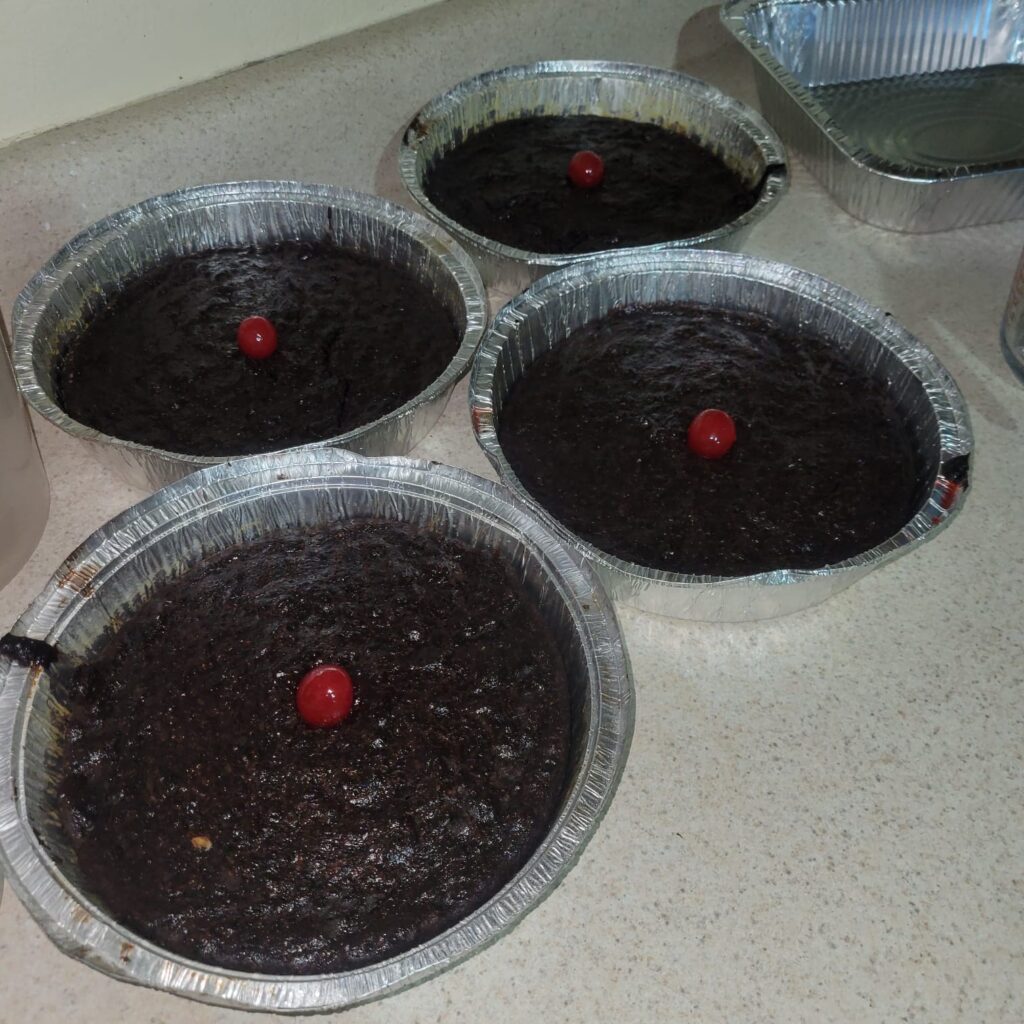
Then there’s the Christmas cake, the one some people call black cake. It’s dark, dense and rich, made with all that fruit that’s been soaking for months, plus browning for the colour. After it comes out of the oven, it gets fed more wine and rum so it stays moist for weeks. A slice of Christmas cake goes on every visitor’s plate, and the cake tin travels to family who couldn’t make it. Every family has a cake person, and everybody knows exactly who that is.
Jonkonnu: A Christmas Tradition With Deep Roots
Long before Grand Market and Christmas parties, there was Jonkonnu, also called John Canoe. It’s one of Jamaica’s oldest Christmas traditions. It grew out of the creativity and resistance of enslaved Africans, who used the few days off at Christmas to take to the roads in masks and costumes. Drums, fifes and rattles went with them, and they brought satire and story right into the plantation towns.
The characters are what people remember. Pitchy Patchy is covered head to toe in strips of colourful cloth. Horse Head and Cow Head charge the crowd. There’s the King and Queen, Belly Woman, and the Devil with his pitchfork. Each one carried meaning, part African memory and part commentary on Jamaican life. For generations, children would run screaming and laughing at the same time when the Jonkonnu band came through the district.

AI-generated image for editorial illustration
Today, Jonkonnu is far less common on the road. You’re more likely to see it at a heritage event or cultural festival than coming round the corner on Boxing Day. But it still matters as a reminder that Jamaican Christmas was shaped by people who held on to their culture when holding on was dangerous. It’s part of the same story told in Emancipendence in Jamaica.
Boxing Day, Parties and How the Season Has Changed
Ask an older Jamaican about Christmas nights and you’ll hear about the district. A sound system strung up at the square or somebody’s yard, the selector playing till morning, and the whole community in one place. Or you’ll hear about the verandah: a few chairs, a bottle on the table, dominoes slamming, and stories getting bigger with every round. That was the Christmas lime, and it didn’t need a ticket.
Now the season is a lot louder. From mid-December the party calendar fills up. There are Christmas Eve events, all-white parties, beach parties and big-name stage shows, especially around Kingston and the tourist towns. For younger Jamaicans, going out is now as much a part of Christmas as dinner. Many families who live abroad plan their trip home around the December calendar.
Boxing Day keeps it going. Families head to the beach or the river, there are day parties and evening sessions, and in Kingston, Boxing Day is opening night for the National Pantomime at the Little Theatre, a tradition now more than 80 years old. Leftovers get packed into foil and brought along. Nobody cooks from scratch on Boxing Day if they can help it.
But the old Christmas hasn’t gone. It has just made room. The same person who went to a party Christmas Eve is at Granny’s table the next afternoon. The verandah lime still happens, just before or after the dance. Christmas in Jamaica is still about the people you spend it with. It just runs later and louder than it used to.
Christmas Across the Waters
For Jamaicans living abroad, Christmas is the time of year home feels closest and farthest away at the same time. It shows up in the barrel. All year you’ve been filling it with clothes, shoes, tinned goods and toiletries, and it has to ship by a certain date so it reaches yaad before Christmas. It shows up in the phone calls too, now video calls, with the whole family crowded into the frame and everybody talking at once.
And it shows up in the kitchen. In Brooklyn, Toronto, London and Miami, people track down dried sorrel at the Caribbean grocery, soak their fruit in a jar in the corner of the apartment, and hunt for gungo peas in a can because fresh ones are hard to come by. The cake gets made from Granny’s recipe, written on the back of an envelope. It’s not exactly the same, and we all know it. But the smell of sorrel and ginger in a cold northern December brings it back like nothing else. If you know that feeling, you’ll know the list in Craving Home.
Plenty diaspora families do the reverse too and go home for Christmas. The airport in mid-December is full of people with suitcases right at the weight limit and that same look on their face: mi reach.
What Made It Feel Like Christmas?
Every Jamaican has one thing that tells them Christmas has arrived. For some it’s the new curtains going up. For others it’s the first sip of sorrel, Grand Market night, or the cake tin coming down from the top of the cupboard. For some it’s simply the Christmas breeze.
So tell us: what was yours? Whether you’re spending this Christmas on the island or far from it, share your memories in the comments. We read every one, and the best of them might just turn up in the December Letters to Yaad.
Merry Christmas, from our yaad to yours.
Walk Good. 🇯🇲
Every Nook. Every Cranny. All Jamaican.
Pingback: Jamaican White Rum: Not Your Ordinary Rum - Showcase Jamaica