By the time Christmas is over, plenty of Jamaicans are already checking how the August holidays fall. A Monday or Friday can mean a long weekend; add a leave day or two and it becomes a proper break. By summer, Negril rooms are booked, party packages are circulating, flights home are pricier, and everybody knows whether August 1 and August 6 are working in their favour.
Emancipation Day on August 1 commemorates the end of slavery in Jamaica in 1838. Independence Day on August 6 marks Jamaica becoming an independent nation in 1962 — five days later, and together the two are commonly called Emancipendence: a season of reflection, national pride, music, cultural events, travel and, depending on where you are, a serious amount of partying.
The pairing feels natural now — Emancipation first, Independence five days after, one flowing straight into the other. But it wasn’t always this way. For 35 years, Jamaica celebrated Independence Day with no Emancipation Day on the calendar at all.
Emancipendence in Jamaica is therefore about more than two holidays on the calendar; it is the story of two different freedoms and why the country chose to preserve both.
August 1, 1838: The Day Freedom Actually Arrived
The Slavery Abolition Act took effect across most of the British Caribbean in 1834, but for the more than 300,000 enslaved people in Jamaica, what followed was not full freedom. Instead, they entered a four-year “apprenticeship” system that kept them bound to the same plantations and under the authority of the same planters in almost everything but name.
Full, unconditional freedom did not take effect until August 1, 1838.
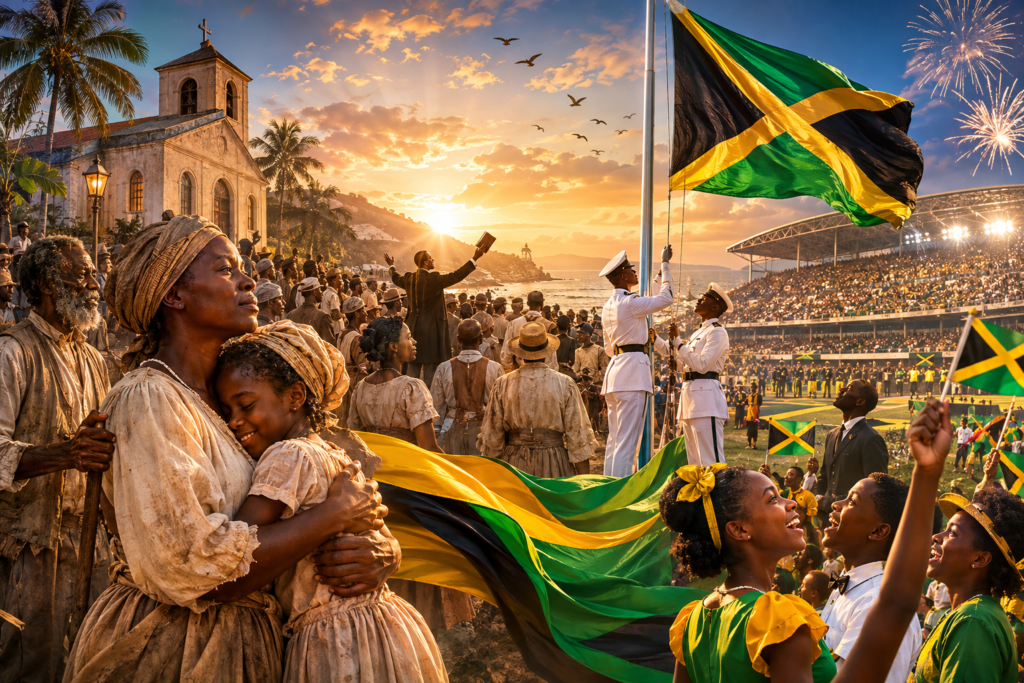
Accounts from the period describe formerly enslaved people gathering in churches and town centres on the night of July 31, waiting for midnight. In Spanish Town the following day, thousands joined a procession to Government House, where the Governor read the Proclamation of Freedom to the assembled crowd.
Jamaicans continued to mark August 1 informally for decades afterward, and Emancipation Day became an official public holiday in 1893.
What August 6 Actually Marks
Jamaica gained political independence from Britain on August 6, 1962. At midnight, the Union Jack was lowered at the National Stadium in Kingston and Jamaica’s black, green and gold flag was raised as the flag of an independent nation for the first time.
Sir Alexander Bustamante became independent Jamaica’s first prime minister. He and his cousin Norman Manley — leaders of rival parties who nonetheless share the title “Fathers of the Nation” — had spent decades shaping the labour and political movements that brought Jamaica to independence. That journey ran from the upheavals of 1938 through the rise of mass political parties, the West Indies Federation, and ultimately the decision to pursue independence on Jamaica’s own. Several of the figures who shaped that journey are remembered among Jamaica’s National Heroes.
The flag’s colours were chosen with intention: black for the strength and creativity of the people, green for the land and hope, gold for natural wealth and sunlight. The national motto adopted around the same time “Out of Many, One People” was itself an answer to the question independence forced the country to ask: who are we, now that we govern ourselves?
Why Emancipation Day Disappeared for 35 Years — and Why It Returned
When Jamaica gained independence in 1962, Emancipation Day was removed from the official holiday calendar. The new nation now had its own founding date to celebrate, and the observance of freedom from slavery was folded into the celebration of freedom from British colonial rule. Independence Day effectively absorbed the space August 1 had previously held. For the next 35 years, Jamaica officially celebrated Independence Day without separately observing Emancipation Day.
By the early 1990s, that felt like a real loss. A National Symbols and Observances Committee, chaired by UWI scholar and cultural icon Professor Rex Nettleford, concluded that the two dates served different purposes and should not have been merged into one observance. Emancipation Day, the committee concluded, calls for a commemoration — a solemn reckoning with what enslaved Jamaicans endured, resisted and overcame. Independence Day calls for a celebration — a recognition of nationhood, sovereignty and what Jamaica has built since. Different holidays for different registers of feeling.
On August 1, 1997, Emancipation Day was restored as a national public holiday — giving Jamaicans back a distinct space to confront the history of slavery, honour the struggle for freedom, and separate that experience from the later achievement of political independence.
It is this pairing that eventually gave us the term “Emancipendence” — the name commonly used for the period between August 1 and August 6, when both holidays effectively form one national season.
What Emancipendence Celebrations Look Like Today
Emancipendence today is more than two public holidays placed five days apart. It begins with ceremonies, vigils and heritage events connected to Emancipation Day, then builds toward the colour, music and spectacle of Independence.
Festival Songs return to the radio. Parish events are already under way. Jamaicans abroad organise their own celebrations, while some make the trip home and plan their visit around the holiday period. Some events ask Jamaicans to reflect on where the country came from. Others are built around music, performance, pageantry and national pride. Then there are the events that are simply about having a good time. Together, they show how Emancipendence in Jamaica has grown into a cultural season with several different sides.
Miss Jamaica Festival Queen: More Than a Crown
Long before Independence Day arrives, the Miss Jamaica Festival Queen Competition begins building excitement across the parishes. Parish finalists are selected before the winners advance to the national coronation, where one contestant is named Miss Jamaica Festival Queen.
Despite the crown and sash, the modern competition is not presented simply as a beauty pageant. Its emphasis is on cultural awareness, communication, leadership and community involvement. Since beginning in 1963, it has become one of the most recognisable pathways through which young Jamaican women represent their parishes and present ideas for community development on a national stage.
Festival Song: The Soundtrack of Independence
Since 1966, the Jamaica Festival Song Competition has attempted to give every Independence season its own soundtrack. The songs are expected to capture something recognisably Jamaican — the humour, language, rhythm, confidence and national pride that define the period.
Toots and the Maytals won the first competition with “Bam Bam,” while Eric Donaldson later became its most successful performer, with songs including “Cherry Oh Baby,” “Land of My Birth” and “Sweet Jamaica.” At their best, Festival Songs do more than win a competition. They enter the national memory, returning every August until it becomes difficult to separate the song from the Independence season itself.
Denbigh: The Country Comes to Town
For many Jamaicans, the Emancipendence season would not feel complete without the Denbigh Agricultural, Industrial and Food Show in Clarendon. First held in 1952, Denbigh brings farmers, livestock breeders, food producers, agricultural businesses and parish displays into one massive national showcase. There are competitions for champion farmers, livestock and Farm Queen, alongside produce displays, food, entertainment and the kind of parish rivalry that can turn a pavilion into a point of pride.
It is easy to treat Denbigh as simply a big agricultural fair, but its place around Emancipation and Independence gives it a deeper meaning. Political independence means little if a country cannot feed itself, support its farmers or build industries from what it grows. Denbigh puts that relationship between agriculture and national self-reliance on full display.
It also represents a side of Jamaica that can get lost when Emancipendence coverage focuses mainly on Kingston stages and Negril parties. At Denbigh, rural Jamaica is not in the background. It is the main event.
Grand Gala: Jamaica’s Biggest National Stage
The official celebrations culminate on August 6 with the Independence Grand Gala at the National Stadium. Music, dance, theatre, costumes and large-scale performances turn the stadium into a showcase of Jamaican history and popular culture, usually ending with the National Pledge, the anthem and fireworks.
Part state ceremony, part cultural production and part concert, Grand Gala is perhaps the closest thing Jamaica has to a national family reunion. Thousands gather inside the stadium, while many more watch from home or through livestreams across the diaspora. It is the moment when government, culture and spectacle share one stage — and when Independence Day feels most visibly national
Grand Gala has also provided a modern stage for Jonkonnu, the centuries-old masquerade tradition that is now far less visible in Jamaican communities than it once was. Including Jonkonnu within the national production helps keep the tradition before a large audience, even as active groups and community performances have declined.
Dream Weekend: The Party Side of Emancipendence
Not every Emancipendence event is built around ceremony or cultural reflection. In Negril, Dream Weekend did not begin as an official Independence celebration. It emerged in 2009 after promoters behind competing Negril party series, including ATI and RTI, decided to work together. Other established events were brought into the new weekend, turning what had been a crowded calendar of rival beach parties into one major festival brand.
Dream Weekend is now one of the largest party festivals in the Caribbean, officially marked on the tourism calendar, pulling thousands of visitors to Negril’s white sand.
Anyone extending the trip beyond the parties can explore more things to do in Negril
Two Holidays, Two Meanings
Emancipation Day and Independence Day sit only five days apart, but they do not tell the same story. August 1 asks Jamaica to remember the people who survived slavery, resisted it and claimed their freedom. August 6 celebrates the country that later emerged as an independent nation, responsible for shaping its own future.
The modern Emancipendence season brings those histories together through ceremony, music, competition, spectacle and celebration. Festival Queen and Festival Song help define the cultural mood, Denbigh places farmers and rural Jamaica at the centre of the season, Grand Gala provides the official national stage, and Dream Weekend shows how the period has also grown into a major social and tourism event.
That mix will not satisfy everyone. Some believe the two holidays should be consolidated, while others argue that combining them would once again erase the distinction Jamaica worked to restore in 1997. But that debate is precisely why both dates still matter. The way people experience Emancipendence in Jamaica has changed over time, but the reason for preserving both dates remains the same. Emancipation and Independence are connected chapters in Jamaica’s story, not interchangeable ones.
One commemorates the freedom that was won. The other celebrates what Jamaica chose to build with it.
Walk Good. 🇯🇲
Every Nook. Every Cranny. All Jamaican.