Few places on earth have punched above their weight in music the way Jamaica has. A small island, an enormous sound.
Ask most people outside the Caribbean to name a Jamaican music genre and they will say reggae. Ask them to name another and — if they know their music — they will say dancehall. The dancehall vs reggae conversation is one the world keeps having — but most people outside Jamaica cannot tell you how the two are connected, where one ends and the other begins, or why the distinction matters.
It matters because these are not just two different sounds. They are two generations of the same family. And like most family stories, understanding the children requires knowing the parents.
Before Reggae: The Family Goes Back Further
Every family tree has deeper roots than people realise. Reggae did not arrive fully formed — it evolved through a lineage of Jamaican sounds that each built on the one before it.
It starts with mento, Jamaica’s original folk music. Acoustic, rhythmic, rooted in African tradition and Caribbean life — mento was the grandfather of the whole family. Then came ska in the late 1950s and early 1960s, picking up speed, absorbing American jazz and rhythm and blues filtering in from the radio, and turning it into something distinctly Jamaican. Ska was the sound of independence — brash, upbeat, full of energy.
Ska slowed down in the mid-1960s and became rocksteady. The tempo dropped, the bass stepped forward, the harmonies deepened. Rocksteady was short-lived but essential — it was the bridge. And from rocksteady, by 1968, came reggae. For the full story of how these sounds evolved into one another, see our guide to Jamaican music history, from ska and rocksteady through reggae, dub and dancehall.
The family line: Mento → Ska → Rocksteady → Reggae. Each one a parent to the next. Each one Jamaican, through and through.
Reggae: The Parent
Reggae arrived at the end of the 1960s and it arrived with weight. Where ska was bright and rocksteady was smooth, reggae carried something heavier — a consciousness, a spirituality, a reckoning with what it meant to be Black and Jamaican in a post-colonial world.
The sound itself was immediately distinctive. The one-drop rhythm — a drumbeat that lands on the third beat rather than the expected one — gave reggae its signature feel. The bass guitar moved to the front of the mix. The rhythm guitar played a choppy, offbeat skank. Live instrumentation was everything: bass, drums, guitar, keys, horns. The full band sound was inseparable from what reggae was.
Reggae was deeply tied to the Rastafari movement — its spirituality, its African consciousness, its rejection of what Rastas called Babylon, the corrupt systems of power. This gave the music a moral seriousness that connected with people far beyond Jamaica’s shores.
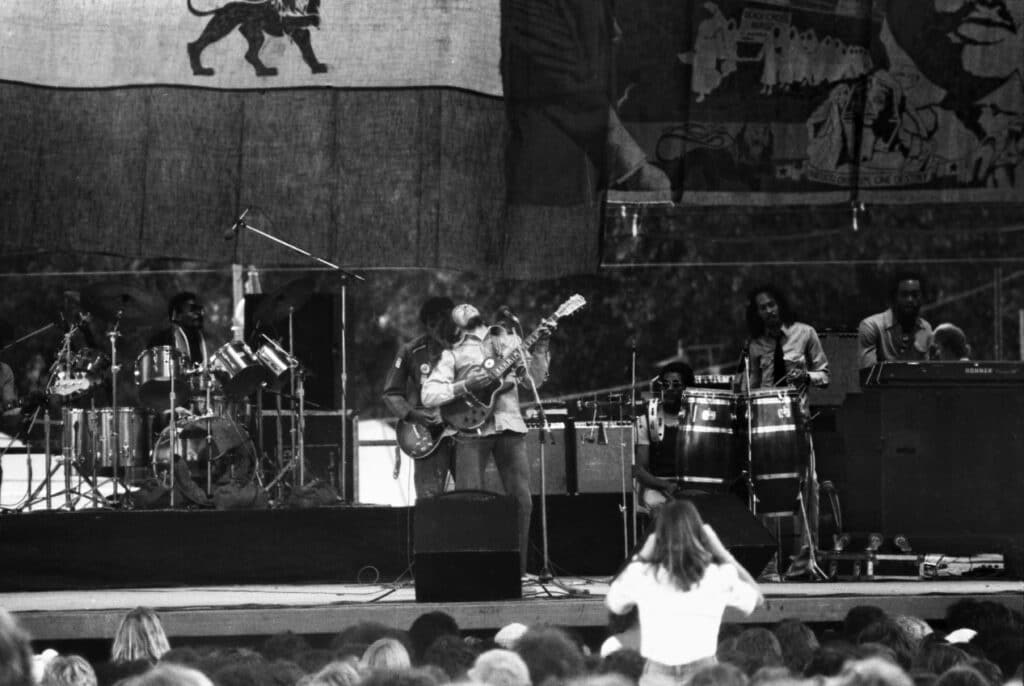
The Pioneers
Toots and the Maytals — Toots Hibbert is widely credited with first using the word ‘reggae’ in a song title with ’54-46 (That’s My Number)’ in 1968. Their sound was raw, soulful, and foundational.
Bob Marley and The Wailers — the artist who took reggae to the world. Albums like Catch a Fire, Rastaman Vibration, and Exodus turned a Jamaican sound into a global phenomenon. Marley remains the most recognisable Jamaican in history.
Peter Tosh — a founding Wailer who went solo with an uncompromising, politically fierce brand of reggae. Equal Rights (1977) remains one of the genre’s defining statements.
Burning Spear — Winston Rodney’s deep roots style, anchored in African consciousness and Marcus Garvey’s philosophy. Heavy, meditative, unwavering.
Jimmy Cliff — whose work on the 1972 film The Harder They Come introduced Jamaican music to cinema audiences internationally, long before Bob Marley became a household name.
In 2018, UNESCO inscribed reggae on its Intangible Cultural Heritage of Humanity list — a formal recognition of what Jamaicans already knew: this music belongs to the world.
The Sound System: The House They Both Grew Up In
Before dancehall was a genre, it was a place. And before it was a place, it was a culture built around the sound system.
Sound systems — mobile rigs of speakers, amplifiers, and turntables operated by a selector and a deejay — were the heartbeat of Jamaican street life from the 1950s onward. A sound system in the yard, a bottle of Wray & Nephew making the rounds — that was the occasion. No venue required, no invitation needed. Operators like Coxsone Dodd and Duke Reid turned these setups into competitive institutions, each sound system building its own following, its own reputation, its own identity.
In the studio, producers like King Tubby began stripping reggae recordings down to their bare bones — removing vocals, isolating the bass and drum, adding echo and reverb. This became dub: an instrumental version of the song built for the sound system. And over these dub versions, deejays began to toast — talking, chanting, hyping the crowd in rhythm. U-Roy was among the first to turn toasting into an art form, scoring multiple hits in the early 1970s by voicing over existing reggae riddims.
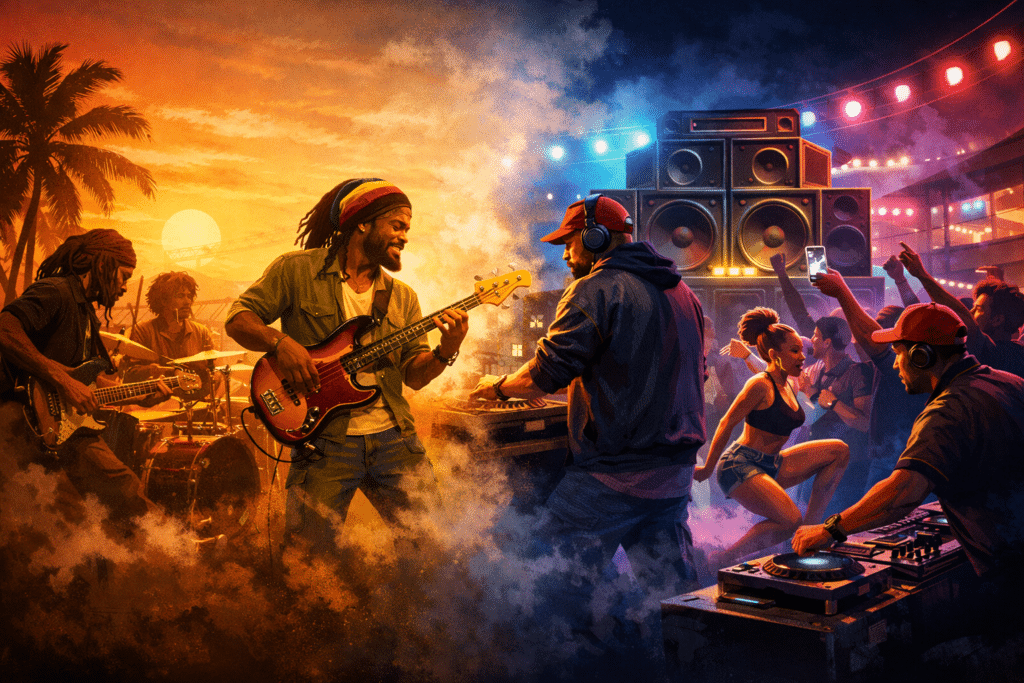
This was the missing link between reggae and dancehall. The sound system took reggae’s riddims, stripped them, rebuilt them, and handed the microphone to a new kind of artist — one who didn’t sing, who talked, who performed. That artist was the prototype of the dancehall deejay.
Without the sound system, there is no dancehall. It is the house both genres grew up in.
Dancehall: The Offspring
By the late 1970s, roots reggae had matured into something serious, international, and — to a generation of younger Jamaicans growing up in Kingston’s inner cities — increasingly distant from their daily reality.
Reggae was speaking to the world. Dancehall spoke to the yard.
What emerged from the sound system sessions of the late 1970s was rawer, faster, and closer to the street. The deejay — not the singer — became the focal point. Digital instrumentation began to replace the live band. Riddims — the instrumental backings that one or many artists could voice — became the currency of the music. A single riddim could be voiced by twenty different artists, each bringing their own energy, their own story, over the same track.
Then in 1985, everything shifted again. Wayne Smith’s Under Mi Sleng Teng — built entirely on a preset from a Casio keyboard, produced by King Jammy — became a massive hit and announced the full arrival of the digital era. The live band was no longer required. The riddim could be entirely electronic. Dancehall’s sound changed overnight, and it has never looked back.
Lyrically, dancehall moved away from Rastafari consciousness and into the everyday — the dances, the fashion, the rivalries, the romance, the street. It was the sound of people who wanted to be seen, heard, and felt — not preached to. Dancehall pushed Jamaican Patois to the centre of the music, making it the most authentically local sound Jamaica had ever produced. And it came with its own visual culture — fashion, dance moves, a whole aesthetic that was inseparable from the music itself.
The Pioneers
Yellowman — one of the first dancehall superstars, his rapid-fire deejay style made him an unlikely but undeniable icon of the early 1980s scene.
Eek-A-Mouse — known for his distinctive sing-jay style, blending singing and deejaying in a way that was entirely his own.
Shabba Ranks — the dominant voice of late 1980s and early 1990s dancehall, who crossed over to international charts and won back-to-back Grammy Awards for Best Reggae Album.
Buju Banton — his 1992 album Mr. Mention became the best-selling album in Jamaican history at the time of release. Over his career Buju would move between hardcore dancehall and deeply conscious roots music, becoming one of the most complex and celebrated artists the island has produced.
Lady Saw — the undisputed Queen of Dancehall. Uncompromising, fiercely talented, she broke barriers for women in a genre that was overwhelmingly male and held her own for decades.
Dancehall vs Reggae: What Actually Separates Them
When people ask about dancehall vs reggae, the instinct is to reach for a simple answer. The reality is more layered. Both grew from the same sound system tradition. Both use the riddim as their structural foundation. Both are expressions of Jamaican life, Jamaican language, and Jamaican identity.
But sit with both long enough and the differences become physical.
But sit with both long enough and the differences become physical.
| Reggae | Dancehall | |
| Tempo | Slow to mid (60–80 BPM) | Faster, more urgent (90–120 BPM) |
| Instrumentation | Live band — bass, guitar, drums, horns | Digital riddims, drum machines, synthesisers |
| Vocal Style | Singing, melodic | Deejaying, toasting, chatting |
| Lyrical Focus | Spirituality, resistance, consciousness | Street life, dance, romance, bravado |
| Language | English and Patois | Primarily Patois |
| Cultural Link | Rastafari movement | Inner-city Kingston yard culture |
Where the Lines Blur
Jamaica doesn’t do neat categories. The most interesting artists have always refused to sit in just one box.
Buju Banton recorded some of the hardest dancehall on the island and also made Til Shiloh (1995), one of the most spiritually profound reggae albums ever made. Sizzla operates across both worlds in the same breath. Damian ‘Jr. Gong’ Marley carries his father’s reggae DNA but moves through dancehall cadence like it’s natural — because for his generation, it is.
And the truth is most Jamaicans don’t stand around debating the distinction. They hear a song. They know what it is. The conversation about which is which is largely had outside Jamaica, by people trying to understand something that Jamaicans simply live.
Reggae Today
Reggae never went anywhere. But a new generation of artists — often called the reggae revival — has brought it back to the foreground with a freshness that honours the tradition without being trapped by it.
Chronixx, Protoje, Koffee, and Etana are carrying conscious reggae into the streaming era. Koffee’s Toast (2018) announced her as one of the most exciting voices Jamaica had produced in years — she was seventeen. Protoje has shown that roots music can be sonically contemporary without losing its soul.
Reggae’s global reputation also remains unmatched. Bob Marley remains one of the most-streamed artists in the world decades after his passing. The music continues to be discovered by new listeners every year, from Japan to Germany to Brazil, all finding something in it that speaks across language and culture.
Dancehall Today
Dancehall’s influence on global popular music in the 21st century is almost impossible to overstate — and almost entirely uncredited.
Dancehall riddims have quietly underpinned some of the biggest international pop, R&B, and hip-hop records of the last two decades. The rhythmic structure, the bass patterns, the deejay cadence — artists and producers across the world have drawn from the dancehall tradition and made it their own. The influence runs deeper than most people realise.
On the island, the current generation includes artists like Vybz Kartel, Popcaan, Shenseea, Masicka, and Valiant — names that have resonated both locally and across the diaspora, each bringing their own style to the genre.
Dancehall’s reach has extended well beyond Jamaica — its rhythms and cadence are woven into the DNA of Afrobeats, heard clearly in artists like Burna Boy who have openly acknowledged the Jamaican influence on their sound. Reggaeton tells a similar story: its foundational beat, the dembow riddim, traces directly back to Shabba Ranks’ 1991 recording — a Jamaican rhythm that Panamanian producers carried into Spanish, and that Puerto Rican artists then took mainstream. The world ran with it from there.
At its core dancehall remains: the riddim, the deejay, the dance, the yard.
Frequently Asked Questions about Dancehall vs Reggae
What is the difference between reggae and dancehall?
Reggae emerged in the late 1960s from ska and rocksteady, built around live instrumentation, the one-drop rhythm, and lyrics rooted in Rastafari spirituality and social consciousness. Dancehall came later — late 1970s into the 1980s — faster, more digital, deejay-led, and focused on the everyday realities of Jamaican street life. One is the parent, the other the offspring.
Did dancehall come from reggae?
Yes. Dancehall grew directly out of reggae, evolving through the sound system culture of Kingston in the late 1970s. As producers began building digital riddims and deejays started toasting over instrumental versions of reggae tracks, a new genre took shape. Dancehall is reggae’s child — same roots, different direction.
Which came first, reggae or dancehall?
Reggae came first. It emerged around 1968 from earlier Jamaican genres including ska and rocksteady. Dancehall developed roughly a decade later, in the late 1970s, and became the dominant sound of Jamaica through the 1980s.
Is dancehall still popular in Jamaica?
Very much so. Dancehall remains the dominant popular music genre in Jamaica today. Artists like Vybz Kartel, Popcaan, Shenseea, Masicka, and Valiant continue to drive the genre forward, while its influence on global pop, Afrobeats, and hip hop keeps it at the centre of international music culture.
Is reggae still popular today?
Reggae never stopped. A reggae revival led by artists like Chronixx, Koffee, Protoje, and Etana has brought conscious roots music to a new generation of listeners globally. Bob Marley remains one of the most-streamed artists in the world, and in 2018 UNESCO formally recognised reggae as an Intangible Cultural Heritage of Humanity.
What is a riddim in Jamaican music?
A riddim is the instrumental backing track over which one or more artists perform. The same riddim can be voiced by many different artists, each bringing their own lyrics and style. Riddim culture is central to both reggae and dancehall — it is the foundation on which Jamaican popular music is built.
One Family, Still Growing
Reggae gave the world a conscience. Dancehall gave the world a dance floor. Both came from the same small island, the same sound system tradition, the same refusal to be ignored.
They are parent and child — shaped by each other, distinct from each other, and together responsible for one of the most remarkable contributions to global music any nation has ever made.
If you’re coming to Jamaica, don’t arrive with just one playlist. Let the island introduce you to both. And if you’re lucky enough to catch a live session — whether it’s roots reggae under the stars or a dancehall set that shakes the floor — just move. The music will do the rest.
If you leave this island understanding nothing else, understand this: the dancehall vs reggae question has no simple answer — and that’s exactly the point!
Walk Good. 🇯🇲
Every Nook. Every Cranny. All Jamaican.
Before you go — if you want more of Jamaica’s culture, history, and hidden gems delivered straight to your inbox, join Letters to Yaad. One email a month. All Jamaican.