In Jamaican folklore, Bredda Anansi has tricked Tiger, Turtle and his own family out of their food. In story seven of our Anansi series, Anansi and Dry-Head, he finally meets somebody greedier than himself, and that somebody has no body at all.
New to the series? Start here: Who Is Bredda Anansi? · Previous story: Anansi and Turtle
Proverb
“Greedy choke puppy.”
Take more than your share, and it will choke you in the end.
Hard Times Inna Di District
It was a dry year. The rain held back for months, the ground cracked like old leather, and every pot in the district was boiling more water than food.
But Anansi had a hog. A big, fat, grunting hog that he had been feeding on scraps behind the house all year.
Now, in those days, when a man killed a hog, the whole district knew. Neighbours came with their bowls, family came with their bags, and everybody went home with a piece. That was the way.
Anansi looked at his hog. He looked at the hungry district. And he thought, mi nah share none.
So before cock crow, while Crooky and the children were still sleeping, he tied a rope round the hog’s neck and led it deep into the bush, far past where anybody walked, to roast the whole thing for himself.
Two Yeye Inna Di Dirt
Deep in the bush, Anansi built a fire with good pimento wood, the kind that makes meat smell sweet for miles. While the hog roasted, he went digging for a few old yams to go with it.
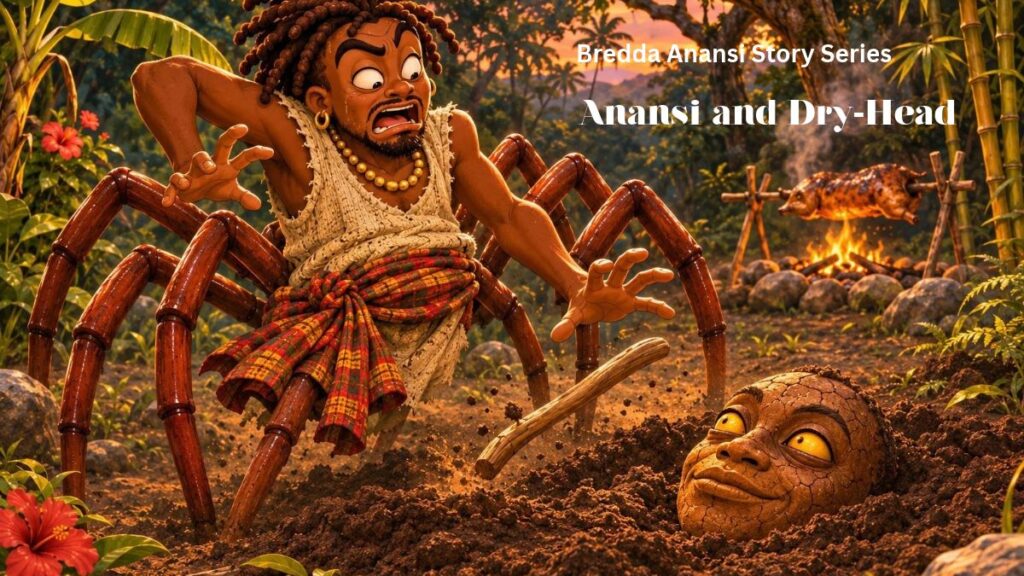
He stuck his stick in the ground and turned the soil. And two eyes looked back up at him.
Anansi dropped the stick.
“Lawd,” he said. “From mi born, a di first time mi see seh dirt can have yeye!”
The eyes blinked. Then the dirt shifted, and Anansi saw that the eyes belonged to a head. Just a head, dry and dusty, with no neck, no shoulders and no body anywhere.
“Pick mi up,” said Dry-Head.
“Mi nah touch yuh,” said Anansi, and he started pushing the dirt back over him.
“Carry mi go a dat big smoke yonder,” said Dry-Head, calm as Sunday. “If yuh don’t carry mi, yuh whole body a go ketch fire.”
Anansi laughed and turned to go. Before he took three steps, his feet started to burn. Then his knees. Then the heat crawled up his back like a line of hot ants.
“Awright! Awright!” Anansi ran back, scooped up Dry-Head, and the burning stopped as if it had never been.
Dry-Head Belly Nuh Have Bottom
When they reached the fire, Dry-Head looked at the hog, golden and crackling.
“Bring it,” he said.
“But a fi mi hog…”
Anansi felt the heat start to tickle his toes. He brought it.
Dry-Head opened his mouth and started to eat. He ate the ribs. He ate the shoulder. He ate the crackling skin that Anansi had been dreaming about since the night before. Anansi stood there watching, and the thing he couldn’t understand was this: where was it going? Dry-Head had no belly. And still he ate, and ate, until there was nothing left but the fire and the smell.
Anansi never tasted a bite.
“Now,” said Dry-Head, licking his lips, “carry mi go a yuh yard.”
And because his feet were already warming up, Anansi did.
For three days, Dry-Head sat in the middle of Anansi’s table and ate everything that came into the house. Crooky’s cornmeal. The children’s bread. The last of the saltfish. Every time Anansi tried to put him outside, the heat came crawling up his legs.
“Anansi,” said Crooky, with her hands on her hips, “yuh did go a bush fi hide one hog from di whole district. Now look wha’ yuh bring home.”
Tacoomah Fi Mind Him
Anansi knew he had to get rid of Dry-Head. And he knew exactly who to give him to.
Bredda Tacoomah lived down the road, and he was almost as greedy as Anansi. So Anansi carried Dry-Head to Tacoomah’s gate and called out sweetly.
“Tacoomah! Mi have a likkle someting yuh might want.”
Tacoomah looked at the head and screwed up his face. “Wha’ dat?”
“Dis?” said Anansi. “Dis a di luckiest head inna Jamaica. Everywhere him go, food deh deh. Mi carry him go a bush, and a whole roast hog just there in front of him. Mi carry him go a mi yard, and food at di table every day.” Every word of that was true, in its own way.
Tacoomah’s eyes went big. “Yuh would lend mi?”
“Fi one day,” said Anansi. “Only, yuh haffi carry him. Never put him down unless him tell yuh.”
Tacoomah held out his arms, and Anansi put Dry-Head in them and ran home faster than he had run in his life.
It took Tacoomah one day to understand. By the second morning his cupboard was empty, his yam hill was dug out, and Dry-Head was looking at him and saying, “Mi want fish now. Carry mi go a sea.”
Tacoomah thought about it. And for once, Tacoomah thought like Anansi.
“Yes, Bredda Dry-Head,” he said. “Mi carry yuh go a di best spot.”
He carried Dry-Head down to the shore, where the fishermen’s boats were coming in, and set him on the wet sand right at the edge of the water. “Sit here so, and yuh will be di first to see di fish.”
Dry-Head smiled. And while he was watching the boats, a big wave came rolling in, picked him up, and carried him out to sea.
Tacoomah stood on the sand and watched until the head was only a dot on the water, and then not even that.

Back a Yard
Anansi heard the news that evening and laughed until he had to sit down. “Mi get rid a Dry-Head!” he told Crooky. “Mi too smart!”
Crooky looked at him. She looked at the empty pot, the empty cupboard, and the empty spot behind the house where the hog used to be.
“Smart?” she said. “Yuh hide one hog from di whole district, and di only one who neva eat it a you.”
Anansi opened his mouth to answer, and his belly growled instead.
The old people say Dry-Head is still out there somewhere, rolling around on the bottom of the sea, waiting for the next wave to bring him back. So if you ever find yourself cooking alone in the bush, hiding your pot from your neighbours, watch the ground. Somebody might be watching you back.
Jack Mandora, me no choose none.
So Why Do We Still Tell This One?
Most Anansi stories end with Anansi winning, or getting caught. This one does something stranger: it sends him a bigger Anansi. Dry-Head is greed with nothing else attached. No body, no family, no district, only a mouth and a pair of eyes. Anansi hid the hog so he wouldn’t have to share it, and in the end he shared it with the one creature who would never share anything back.
That’s what greedy choke puppy means. Taking more than your portion doesn’t fill you up. It finds a way to leave you emptier than you started.
There’s an old district wisdom in it too. When a hog was killed, the meat went round, because next month it would be somebody else’s hog and your bowl would be at their gate. Granny would tell you straight: share yuh likkle, and yuh will never go hungry alone.
Storytelling Roots
Dry-Head turns up in several tellings in Martha Warren Beckwith’s Jamaica Anansi Stories (1924). In George Parkes of Mandeville’s “Inside the Cow,” Anansi digs up two eyes in the earth while hiding a cow to roast alone. Dry-Head threatens him with fire if he isn’t carried, then eats every bit while Anansi gets nothing. Beckwith’s notes record different endings. In one, a bird carries Dry-Head off and drops him deep in the woods. In another, Anansi burns him. In a third, he is passed to Tacoomah, who leaves him by the sea, where a wave carries him away. Our retelling combines these documented episodes, using a hog as some versions do and the sea ending. It is Showcase Jamaica’s own telling, not one teller’s exact version.
Cultural Note
Not every creature in Jamaican folklore is an animal. Alongside Tiger, Turtle and Tacoomah, the old stories are full of stranger figures: duppies, the Rolling Calf, Ol’ Higue, River Mumma. Dry-Head belongs to that eerie side of the yard. He doesn’t chase or bite. He simply turns up wherever there is food that somebody refuses to share. Beckwith also noted that a Hausa story from West Africa closely matches the Jamaican one, a reminder of how far these tales travelled with the people who carried them.
Previous story: Anansi and Turtle · Next story: Anansi and the Two Feasts → · All stories: Who Is Bredda Anansi?
Talk Di Tings
Did anybody ever tell you about Dry-Head? How did he leave the story in your version: carried off by a bird, burned up, or washed out to sea? And who in your family always seemed to appear the minute the pot came off the fire?
Drop your version in the comments, or tag us on Instagram @showcasejamaicamedia.
Walk Good. 🇯🇲
Every Nook. Every Cranny. All Jamaican.