In Jamaican folklore, Bredda Anansi never could say no to a plate of food. In story eight of our Anansi series, Anansi and the Two Feasts, he gets invited to two in one day, and he tries to eat at both. It’s the reason, the old people say, that he has that thin, thin waist to this day.
New to the series? Start here: Who Is Bredda Anansi? · Previous story: Anansi and Dry-Head
Proverb
“One one coco full basket.”
Little by little, the basket fills. Grab for everything at once, and you end up with nothing.
Two Invitation, One Sunday
It was the end of the year, when the yam hills were dug and the breadfruit trees were heavy, and everybody felt like celebrating.
On one side of the river, in the district up the hill, Miss Ivy’s daughter was getting married. Everybody knew what that meant: curry goat, rice and peas, fried fish, and a wedding cake so black and rich with fruit that one slice could put a grown man to sleep.
On the other side of the river, the church down in the valley was keeping Harvest. The altar would be piled high with yam and pumpkin and sugarcane, and after service there would be a Harvest supper long enough to feed the whole congregation twice.
And both of them, on the very same Sunday.
Anansi got both invitations on the same morning. He held one in each hand and looked from one to the other.
“Curry goat,” he said, looking at the left. “Harvest supper,” he said, looking at the right. “How mi fi choose?”
Crooky didn’t even look up from her washing. “Pick one, Anansi. Nobody can eat at two table.”
Anansi smiled. Nobody, he thought. But mi a nuh nobody.
Di Rope Plan
That Saturday night, Anansi took the longest rope he owned and tied the middle of it tight around his waist. Then he called his two sons.
“Listen good,” he said. He gave one end of the rope to the first son. “Tomorrow, yuh tek dis up a di wedding. When dem tek di curry goat off di fire, yuh pull. Pull hard, and mi will know fi come.”
He gave the other end to the second son. “An’ yuh tek dis down a di church. When Harvest supper ready, yuh pull. Hard.”
The boys looked at each other. “But Pupa, wha’ if…”
“No but,” said Anansi. “Mi have it all work out. Di wedding a go eat early. Harvest a go eat late. Mi will eat one, then run go eat di other one.”
The boys shrugged. He was their father. So the next morning, one went up the hill and one went down to the valley, each carrying his end of the rope, and Anansi sat on a stone by the river in the middle, with the rope stretched out both ways from his belly, waiting.
Pull, Bwoy, Pull!
Now, nobody had told Anansi that the wedding was running late. The bride’s car broke down twice on the way to church, and the parson preached so long that half the guests fell asleep.
And nobody had told him that the Harvest service was running early, because the parson down in the valley had a cold and wanted to get home.
So it happened, right at midday, that up on the hill they lifted the lid off the curry goat, and down in the valley they rang the bell for Harvest supper.
At the very same moment, both boys pulled.
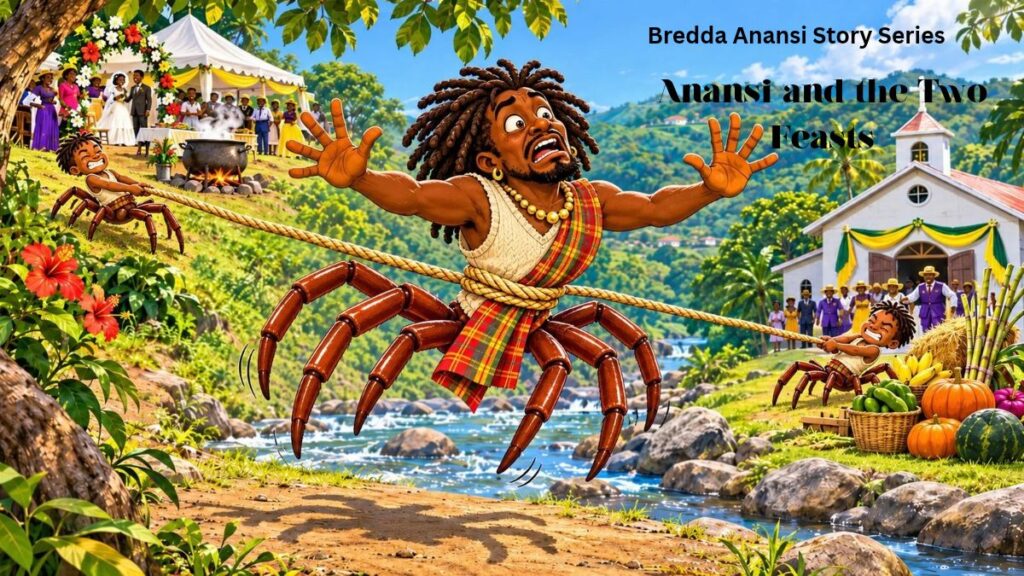
Anansi shot up off his stone. The rope jerked him toward the hill. Then it jerked him toward the valley. Then both at once, so hard that his feet lifted clean off the ground.
“Hol’ on! Hol’ on!” he bawled. “One at a time!”
But up on the hill, the first son thought, Pupa nah come. Mi haffi pull harder. And down in the valley, the second son thought the very same thing.
So they pulled harder.
Every time the rope tugged back, each boy thought his father was stuck on the other side and needed more help. So he pulled harder still.
And Anansi hung there in the middle, stretched between the wedding and the Harvest, the rope squeezing tighter and tighter around his waist, shouting for somebody, anybody, to let go.
Plate Done
Nobody let go until the food was finished.
Up on the hill, the guests ate every bit of curry goat and scraped the rice and peas from the bottom of the pot. Down in the valley, the congregation finished the Harvest supper and carried home what was left in their bags. Only when the last plate was washed did the two boys wonder what had happened to their father, and walk back to the river, winding up the rope as they came.
They found Anansi lying on the riverbank, groaning, with his belly empty and his middle pinched in so thin they could have closed their fingers around it.
“Pupa,” said the eldest, “yuh never come.”
Anansi just lay there and looked at the sky.
When he got home, Crooky took one look at him and folded her arms.
“So, Anansi. Which one yuh did choose?”
He didn’t answer. He couldn’t. His belly had nothing in it, and his waist never came back the same.
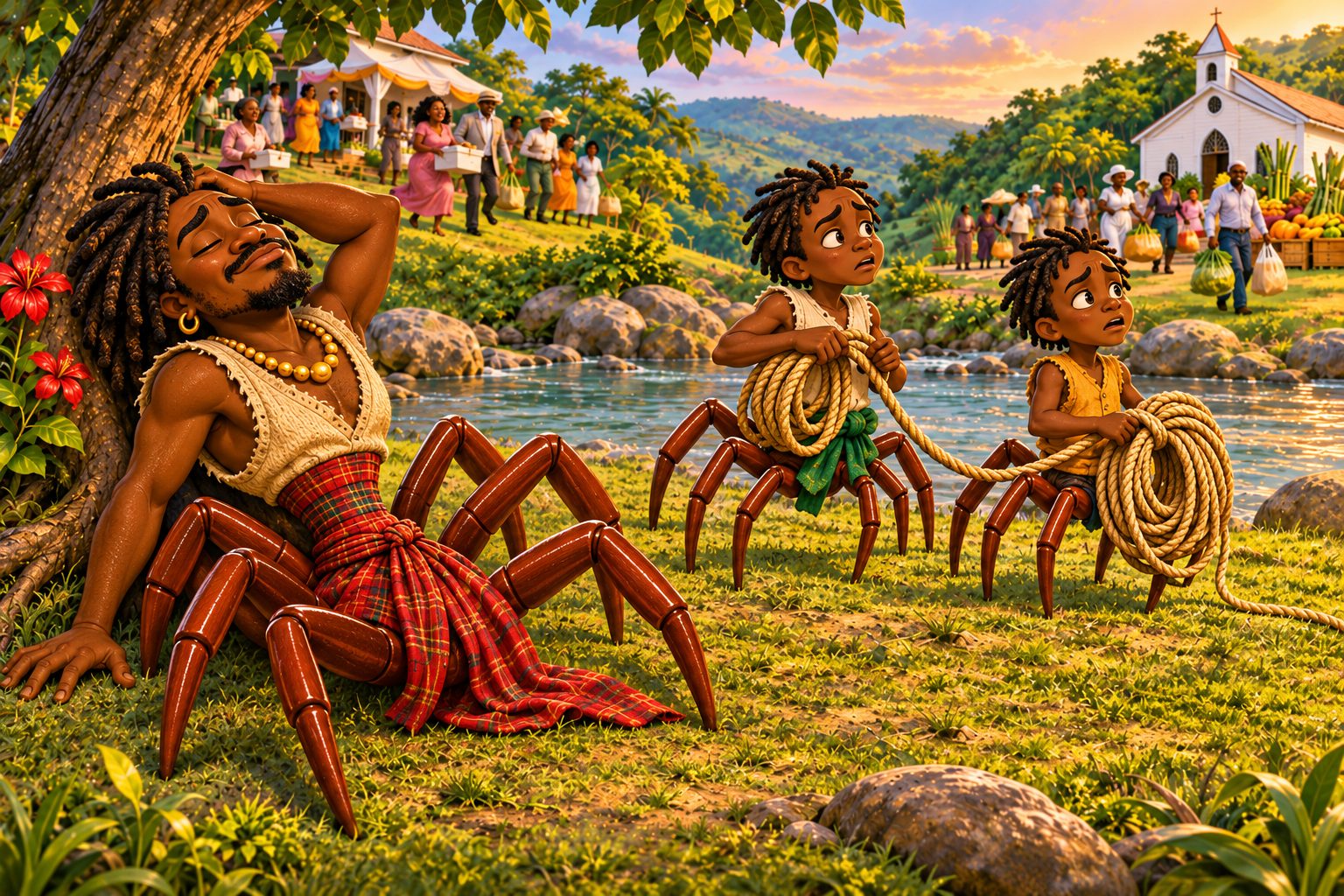
And that’s why, to this day, Anansi has the thinnest waist you ever saw, pinched in tight in the middle, from the day he tried to eat at two tables and ate at none.
Jack Mandora, me no choose none.
So Why Do We Still Tell This One?
Every one of us has been Anansi on a busy Sunday. Two parties, one evening. Two invitations you don’t want to turn down. The cousin’s christening and the friend’s birthday, and you try to do a quick run to both and end up on the road between them, eating a patty in the car.
This story takes that feeling and stretches it, literally, to its funniest end. Anansi didn’t lose simply because he was greedy. He lost because his greed wouldn’t let him choose. He wanted every good thing at once, and the world doesn’t schedule itself around one man’s belly.
That’s the wisdom in one one coco full basket. Good things come one at a time. Fill your plate at one table, enjoy it properly, and Granny would tell you the other table will still be there next time. Try to grab both, and you might just end up on the riverbank with a rope round your waist.
Storytelling Roots
The tale of Anansi and the two feasts comes from the Ashanti (Akan) storytelling tradition of Ghana, where it is one of the best-known explanations for the spider’s narrow middle. Folklorist Harold Courlander recorded “Two Feasts for Anansi” on Folkways’ Ashanti Folk Tales from Ghana (1959), and related thin-waist Anansi tales are told across the Caribbean. We haven’t found this exact tale in Martha Warren Beckwith’s Jamaica Anansi Stories (1924). That says more about the limits of one collection than about what Jamaican grandparents told on their verandahs. What you’ve just read is Showcase Jamaica’s own retelling, with a Jamaican wedding on one side of the river and Harvest on the other.
Cultural Note
Harvest is a cherished tradition in many Jamaican churches. Congregations bring produce such as yam, pumpkin, breadfruit, sugarcane and bananas to decorate the church and give thanks. Some celebrate with a shared meal or other gathering afterward. In the diaspora, the spirit of giving thanks also feels familiar around the Thanksgiving table. And curry goat at a Jamaican wedding? Anansi certainly wouldn’t want to miss that. Put those two celebrations on the same Sunday, and you can understand his problem, even if you can’t forgive his solution.
Previous story: Anansi and Dry-Head · All stories: Who Is Bredda Anansi?
Talk Di Tings
What’s the most events you ever tried to fit into one day? And be honest: did you ever leave one party early because you heard the food was better at the other one?
Drop your story in the comments, or tag us on Instagram @showcasejamaicamedia.
Walk Good. 🇯🇲
Every Nook. Every Cranny. All Jamaican.