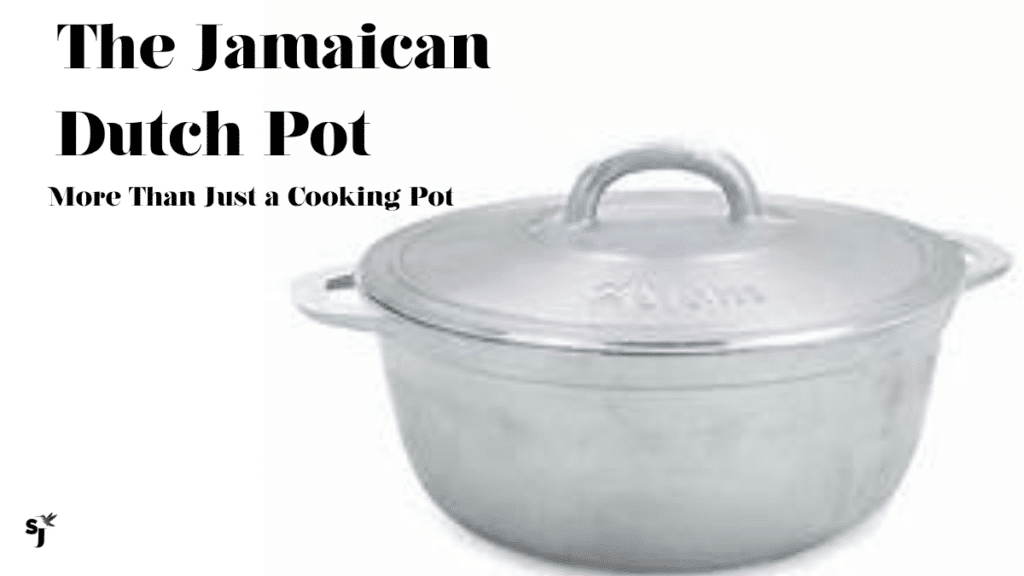
The Jamaican dutch pot built Jamaican cooking — and never left the kitchen.
The first thing some of us bought for our own kitchen wasn’t a knife set or a blender. It was a dutch pot. Not because anyone told us to. Because somewhere deep in the memory of every Jamaican who has ever watched food being made, the Jamaican dutch pot was always there. Heavy, dependable, already knowing what to do.
It is the most important piece of equipment in a Jamaican kitchen. Not the most glamorous. Not the most talked about. The most important.
Jamaican food is not just recipes. It is equipment, heat, time, and patience. The Jamaican dutch pot is part of the recipe.
Every Jamaican kitchen has a dutch pot. Not one — a collection.
What Is a Jamaican Dutch Pot?
A Jamaican dutch pot is a heavy, thick-walled cooking pot — wide base, slightly domed lid, built for long, slow cooking over heat. In Jamaica it is the workhorse of the kitchen. The pot that makes rice and peas on a Sunday. The pot that stews chicken until the meat falls off the bone. The pot that steams callaloo on a Tuesday morning without burning the bottom.
It goes by different names in different parts of the Caribbean, but in Jamaica it is simply the dutch pot — and it is not optional. It sits at the centre of Jamaican cooking the way thyme and scotch bonnet do. Remove it from the equation and you’re cooking something else entirely.
The Aluminium Truth — What Jamaicans Actually Cook In
Online food circles love cast iron. They’ll tell you it’s the superior material, the authentic choice, the one worth investing in. And cast iron has its merits. But in Jamaican homes — especially growing up — it was always aluminium.
Lighter. More affordable. Conducts heat well enough. Lasts for decades if you treat it right. The aluminium Jamaican dutch pot is what generations of Jamaican grandmothers cooked in, and what most Jamaican homes still cook in today. There is nothing inferior about it. It is what the food was built around.
Cast iron has become more common as a lifestyle choice — imported, expensive, heavy. The aluminium pot is what was always there. Both cook good food. But only one tells the real story of the Jamaican kitchen.
The Mismatched Set — Every Size Has a Job
No Jamaican kitchen has a matching set of dutch pots. That’s not how it works. What you have is a collection — acquired over time, each one assigned a role, each one in a different state of survival.
The Big One — Soup and Rice
This is the pot that comes out on a Saturday. The soup pot. Big enough to hold enough red peas soup for the whole yard, deep enough for the rice and peas on Sunday. It lives at the back of the stove or on the floor beside it. Nobody touches the big one for small jobs.
The Medium One — Meats
Brown stew chicken. Curry chicken. Oxtail. The medium dutch pot is where the serious cooking happens — the long, slow braises, the dishes that need time and attention. This pot has seen things. Its sides are stained with years of browning and seasoning and it is better for it.
The Small One — Everything Else
Frankfurters. Fried plantain. A quick scramble of eggs. The small dutch pot is the utility player — used for frying, for heating leftovers, for anything that doesn’t need the big production. In some kitchens this is the one that gets pressed into service most often.
And then there are the details that make it real. The handle on one that bruk off sometime around 2005 and nobody replaced it because the pot still works. The cover for another that went missing and a plate has been doing its job ever since. The dent in the side from the time it was dropped. None of this stops the cooking. A Jamaican dutch pot doesn’t need to be perfect to be essential.
The handle bruk off. The cover went missing. The pot still works.
That’s the Jamaican dutch pot.
The Coal Stove — Where the Dutch Pot Really Came Alive
Before gas burners and electric stoves, the dutch pot lived on the coal stove or over an open fire in the yard. That tradition hasn’t disappeared — it’s just become more occasional.
Christmas at the country yard. The whole family there. Inside, the gas stove handling everything that needed watching. Outside in the yard, the coal stove doing what it always did — the long jobs. The big pots. Curry chicken in a dutch pot sitting over slow coal heat, the gravy just starting to build, thyme stems visible in the steam rising from the lid. That image is not nostalgia. It is how Jamaican food was built.
The dutch pot was made for this kind of cooking. The thick base handles the uneven heat of burning coal. The heavy lid traps steam through long cooking times. The wide surface allows for the slow, patient reduction that makes Jamaican stews what they are.
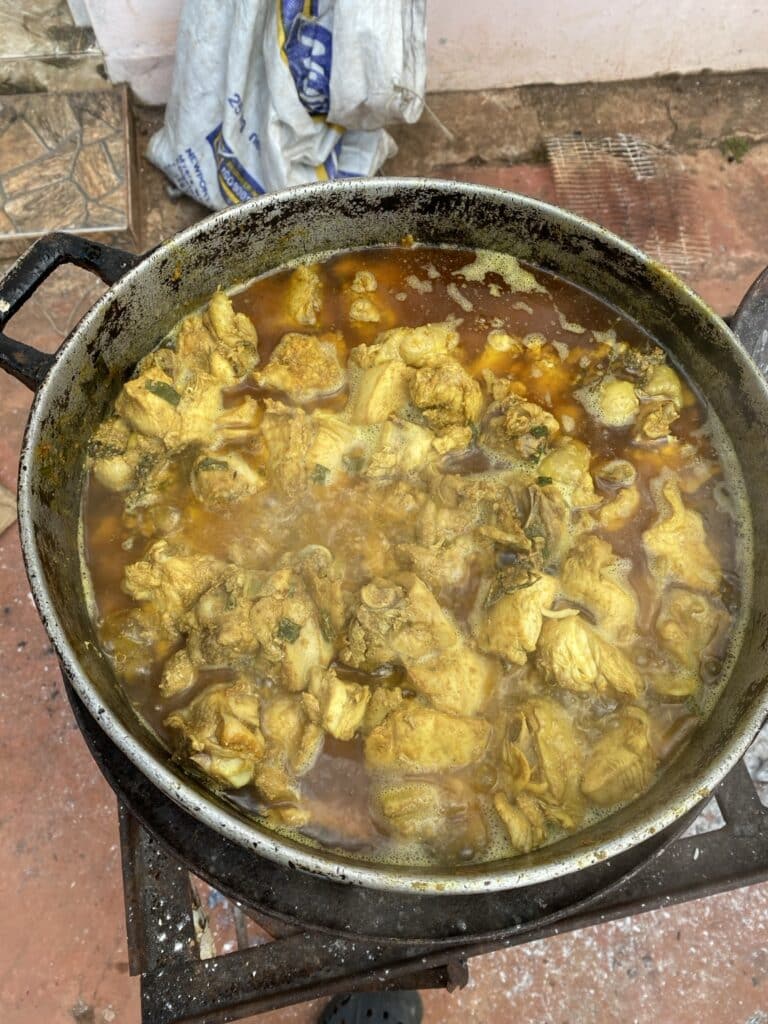
The coal stove had its own jobs beyond the big celebratory pots. Tun cornmeal — cooked low and slow until thick — was a coal stove job in many yards. Coconut drops, the old-time Jamaican sweet made from coconut and sugar cooked to the right stage, needed that steady, controllable coal heat. And then there’s potato pudding — cooked with the technique Jamaicans describe as ‘hell a top, hell a bottom, hallelujah in the middle.’ Hot coals beneath the pot and hot coals placed on top of the lid simultaneously, the pudding baking from both directions at once. No gas stove replicates that. It is a dutch pot and coal stove technique, full stop.
Hell a top, hell a bottom, hallelujah in the middle —
potato pudding on a coal stove, the Jamaican way.
Coal stove cooking is rare now. Gas and electric stoves are the everyday reality in most Jamaican homes. But when a big occasion calls for it — Christmas, nine night, a community cook-up — somebody sets up the coal stove in the yard. And here is where it gets practical: in the modern kitchen, nobody keeps a dedicated outside pot anymore. When the coal stove comes out, you take a regular kitchen pot, bring it outside, put it on the coal, and cook. When you’re done, that pot gets a proper scouring before it comes back inside. Coal fire leaves its mark on the outside of a pot and that baxside needs to be clean before it crosses the threshold. That’s just how it is.
The smell of coal mixing with thyme and scotch bonnet rising from a pot in the yard is something that stays with you. Anyone who grew up around it knows exactly what that smells like. And it’s different from anything a kitchen stove produces — not better or worse, just different. A specific kind of Jamaican memory that lives in the nose as much as anywhere else.
Why the Jamaican Dutch Pot Is Essential to Jamaican Cooking
This is not superstition. It is physics.
The thick aluminium base distributes heat evenly across the bottom of the pot, which means food cooks at a consistent temperature rather than hot in the middle and cooler at the edges. The heavy lid traps steam inside, which creates a self-basting environment — the moisture that rises comes back down onto the food instead of escaping into the kitchen.
The result is food that is more tender, more flavourful, and more forgiving of the kind of low, slow cooking that Jamaican recipes are built around. Rice and peas cooked in a dutch pot has a different texture from rice cooked in a thin saucepan. Stew chicken has a different depth. Even callaloo steamed in a dutch pot tastes more rounded than the same callaloo done in something lighter.
You can taste the difference. Jamaicans who grew up eating food from a dutch pot know it immediately when something has been cooked in a thinner pot. It’s not snobbery. It’s just true.
Dutch Pot vs Pressure Cooker — The Jamaican Kitchen Debate
Every Jamaican kitchen has both. And every Jamaican cook has a position on when each one gets used.
The pressure cooker is speed. Hard foods that would take forty minutes in the dutch pot are done in fifteen under pressure. Tough cuts of meat — oxtail, cow foot, pig tail — get tender in a fraction of the time. When you’re cooking on a weeknight and time is short, the pressure cooker earns its place.
The dutch pot is flavour. The long, slow reduction. The gravy that builds over an hour of low heat. The rice and peas that absorbs the coconut milk gradually rather than being forced. You cannot rush a dutch pot dish and get the same result.
The Jamaican solution, as with most things, is practical: use both. Saturday soup might start in the pressure cooker — get the pig tail tender, get the kidney beans soft — and then move to the dutch pot to finish. The broth reduces, the spinners go in, the flavours come together. The pressure cooker did the heavy lifting. The dutch pot did the finishing.
Rice and peas still goes in the dutch pot. Always. No pressure cooker can do what a dutch pot does to coconut milk and kidney beans cooking slowly with thyme and pimento. That is not up for debate.
The pressure cooker is speed. The dutch pot is flavour.
The Jamaican kitchen needs both.
Why Your Grandmother’s Dutch Pot Cooks Better Than Yours
A dutch pot improves with age. Not in the way cast iron is seasoned — there’s no ritual oiling or curing required. It happens simply through use. Years of cooking build up a residue on the inside of the pot that subtly influences everything that comes after it.
Your grandmother’s dutch pot has been making rice and peas since before you were born. It has absorbed decades of thyme, scotch bonnet, pimento, and patience. When she makes something in that pot, those layers of history are part of the dish.
Your pot is still earning it. Give it time.
Your grandmother’s pot has been building flavour for decades.
You’re still earning yours.
Beyond the Kitchen — The Dutch Pot in Jamaican Life
The Community Pot
In country communities across Jamaica, there is always one person who has the extra large dutch pot. Not just big — extra big. The kind of pot that doesn’t fit on a regular stove and gets used over an open fire in the yard.
This pot belongs to the community, not just the household. When there’s a nine night, a repast, a community gathering that needs feeding, everyone knows who to call. The pot comes out, the fire goes down in the yard, and mannish water or soup gets made in quantities that no regular kitchen pot could handle. It goes back when the cooking is done, seasoned a little more than before, ready for the next time it’s needed.
That is not a kitchen tool. That is community infrastructure.
The Pot Cover as Percussion
When Jamaicans celebrate — whether it’s a national sporting moment, a community win, or a neighbourhood gathering — pot covers appear. Not drums. Not horns. Pot covers, banged together to make noise, to signal joy, to be heard across the road and down the lane.
The fact that the pot cover travels from the kitchen to the street without anyone thinking twice about it tells you exactly what the dutch pot means in Jamaican culture. It is not just how we cook. It is part of how we live.
From the kitchen to the street — the dutch pot goes where Jamaica goes.
Getting Your Own Jamaican Dutch Pot
If you’re starting out, a medium-sized aluminium dutch pot is the right first investment. Big enough for rice and peas, deep enough for a small pot of stew chicken. Something in the 5–7 litre range covers most everyday cooking needs.
You can find aluminium dutch pots at Caribbean grocery stores, Jamaican food shops, and online. If you’re in Jamaica, any market or hardware store will have them.
Disclosure: This article contains affiliate links. If you purchase through them, Showcase Jamaica may earn a small commission at no extra cost to you.
→ Aluminium Dutch Pot — Amazon
One note: don’t overthink the size. Jamaicans have always made do with what was available. Start with one good medium pot and work up from there. The collection builds itself over time.
Frequently Asked Questions About the Jamaican Dutch Pot
What is a Jamaican dutch pot made of?
Most Jamaican dutch pots are made from aluminium — lightweight, affordable, and excellent at conducting and retaining heat. Cast iron versions exist and have become more popular in recent years, but aluminium is what most Jamaican households have traditionally used and continue to use.
Why do Jamaicans cook in a dutch pot?
The dutch pot’s thick base and heavy lid create even, consistent heat and trap steam inside the pot. This makes it ideal for the long, slow cooking that defines Jamaican food — rice and peas, stew chicken, oxtail, soup. Food cooked in a dutch pot genuinely tastes different from food cooked in a thinner pan.
What is the difference between a dutch pot and a pressure cooker in Jamaican cooking?
The pressure cooker is speed — it gets tough cuts tender and legumes soft quickly. The dutch pot is flavour — slow reduction, gradual absorption, the long braise. Many Jamaican cooks use both: the pressure cooker for the heavy lifting on tough ingredients, the dutch pot for finishing and for dishes like rice and peas that need slow, patient cooking.
What size dutch pot should I buy?
Start with a medium pot in the 5–7 litre range — big enough for rice and peas for a family, deep enough for a good stew. From there, add a larger pot for soup and a smaller one for everyday frying and quick cooking. Most Jamaican kitchens have at least three sizes in rotation.
The Jamaican dutch pot is not just a pot.
It is where Jamaican food, Jamaican family, and Jamaican memory all meet.
Your Turn
Every Jamaican has a dutch pot story. The handle that bruk. The cover that went missing. The neighbour with the enormous pot that came out for every nine night on the road. The curry chicken on the coal stove at Christmas in the country yard. Tell us yours in the comments below.
Walk Good. 🇯🇲
Every Nook. Every Cranny. All Jamaican