You’re home alone. The house is quiet. Then — a sound. Something shifts in the next room. A creak. A knock. Nothing follows.
Now, if you grew up in any other country, you might check the windows, blame the pipes, and go back to sleep.
But if you grew up Jamaican?
First you plead the blood of Jesus. Loud. With authority. And if that doesn’t settle your spirit — you address the duppy directly.
“A betta yuh come out enuh, cause yuh naah help pay nuh rent in yah”
That, right there, is the Jamaican relationship with the supernatural in one sentence. We believe. Deeply. But we are also deeply practical. Acknowledge the spirit world, yes — but don’t let it take liberties.
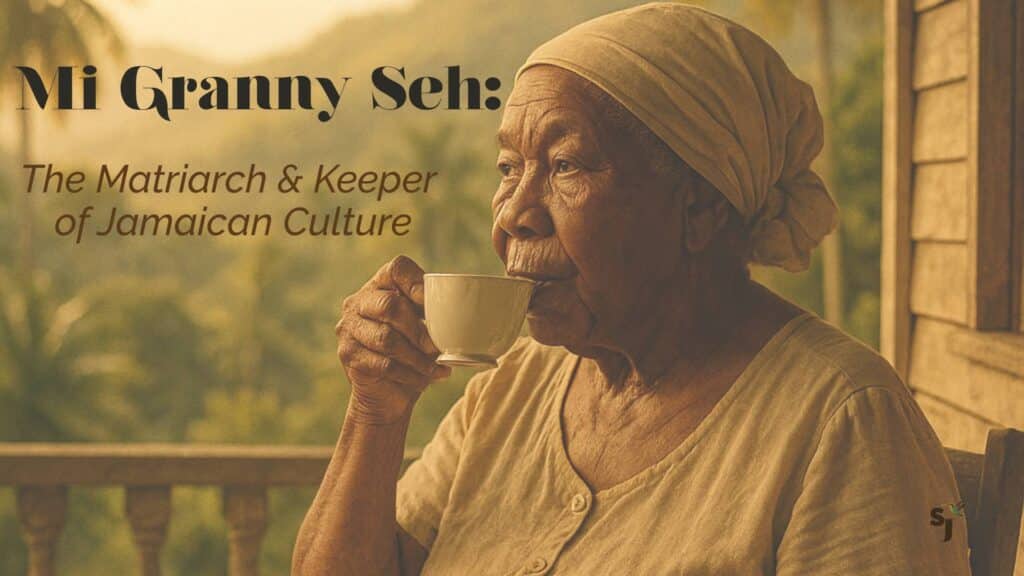
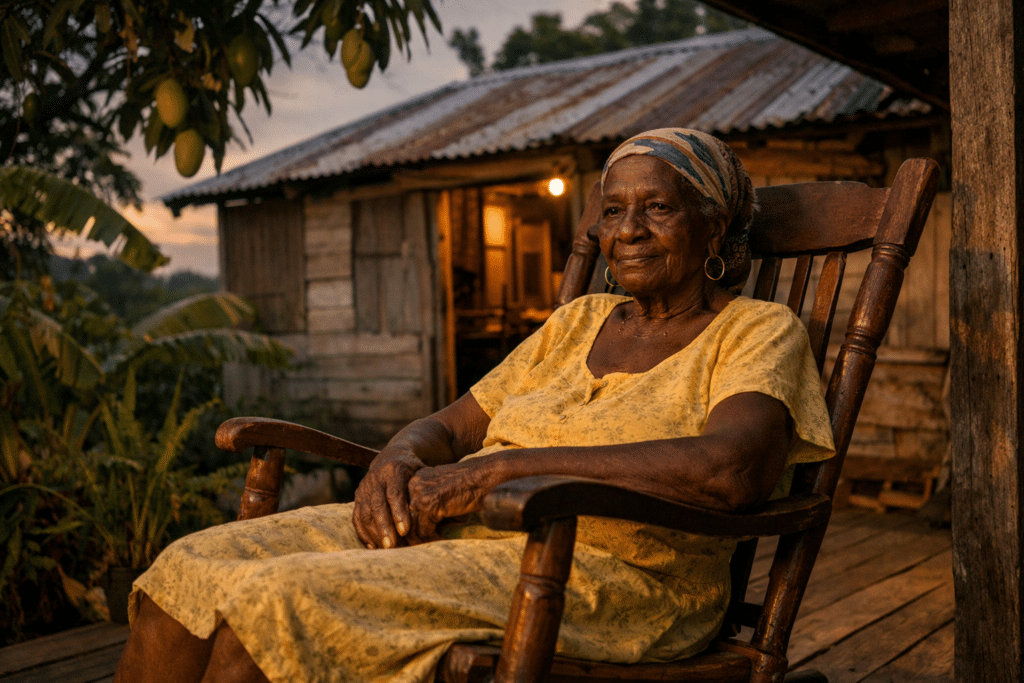
Jamaica is one of the most religious countries in the world. We have more churches per square mile than almost anywhere on earth. And yet — we also have duppies. We have Obeah. We have Nine Nights, and Rolling Calves, and women in white standing on dark country roads after midnight. We have rum poured on the ground before the first brick is laid. We have grannies who burned your hair clippings so nobody could work obeah on you. As Mi Granny Seh — our culture pillar on the Jamaican grandmother — makes clear: Granny was the keeper of all of it.
These are not contradictions. This is Jamaica.
Jamaican superstitions are part of the island’s living folklore — a mix of African spiritual traditions, Christian belief, and everyday wisdom passed down through generations. The superstitions and spiritual beliefs you grew up with didn’t come from nowhere. Most of them trace a direct line back to West Africa — carried across the Middle Passage by enslaved people who refused to let their spiritual world be taken from them. Centuries later, those beliefs are still alive in Jamaican kitchens, yards, taxi cabs, and construction sites.
This isn’t superstition. This is memory. This is identity. This is Jamaica.
Let’s talk about it.
Money, Luck & The Signs That Wealth Is Coming
Jamaicans have always had a finely tuned radar for signs of financial fortune. And misfortune. Sometimes the difference between the two is which hand is itching.
The Itching Palm
If your right palm itches, money is coming to you. If your left palm itches, money is leaving. Simple, clear, non-negotiable. You will hear this from a grandmother, a taxi driver, a market vendor — and all of them will tell you the same thing with complete conviction.
The Patois version goes:
“If yuh hand miggle scratch yuh, yuh ago get sum money.”
There’s even a foot-bottom version — if the sole of your foot itches, you’re getting new shoes. Some elders give it a darker reading: it means someone in the family is about to die. Which version you hear probably says a lot about the personality of the person telling you.
Don’t Put Your Bag on the Floor
This one is said so often it barely registers as superstition anymore — it’s just rule. Your bag, your purse, your wallet — it doesn’t touch the floor. The belief is that money carries energy, and the floor is where that energy drains away. Put your money on the ground and you’re telling the universe you don’t value it. The universe agrees and obliges accordingly.
This belief shows up across the Caribbean and parts of Africa. It didn’t originate in Jamaica — it travelled here.
Ants in Your Milk
Find ants in your milk? Money is on the way. The sweetness of the milk attracted them, and sweetness — abundance — is coming to you.
But there’s a second meaning that cuts sharper. Ants in your milk can also mean someone is getting into your sweetness. Your partner is being unfaithful.
Many of these beliefs might sound simple, but Jamaican superstitions have always been about reading signs — whether those signs point to money, love, or danger.
Which brings us neatly to the next section.
Bun Detectors: Jamaica’s Infidelity Warning System
There is a saying in Jamaica that only two things in life are certain: death and bun. Bun — Jamaican slang for infidelity, being cheated on — the kind of thing nobody wants but everybody has an opinion about. Given that wisdom, it makes complete sense that Jamaican folklore would develop an entire early warning system for detecting an unfaithful partner. No therapy required. Just pay attention to the signs.
The Sneeze
A random sneeze — one or two — means someone is talking about you. But if you sneeze three or more times in a row? That is not allergies. That is the universe telling you to check your phone, account for your partner’s whereabouts, and perhaps inspect your milk for ants. You are, almost certainly, getting bun.
The Missing Belt Loop
Dress in the morning. Check your belt. Miss a loop. The whole neighbourhood now knows your business before you do. Missing a loop in your pants or skirt means your partner is being unfaithful. Men are said to quietly double and triple check before leaving the house — not for neatness, but for peace of mind.
Ants in the Milk (Again)
Yes, it bears repeating. The ants found your sweetness. And someone else did too. Context determines which meaning applies — sometimes it’s both at once.
That Jamaicans developed multiple independent superstitions specifically about detecting infidelity tells you something about the culture — and something about human nature. Every society has its anxieties. Jamaica just built a folklore system around them.
Like many Jamaican superstitions, these relationship warnings were less about magic and more about paying attention to patterns and behavior.
Jamaican Superstitions About Death, Duppies and Everyday Life
This is where Jamaican superstition gets serious. The omens of death are not jokes. They are warnings — and generations of Jamaicans have taken them with absolute gravity.
The Owl
An owl screeching over your house is never good news. But three times? Someone in that house is going to die. The traditional counter is to shout “pepper and salt for your mommy” — which sounds absurd and is also deadly serious. Owls in Jamaican belief are carriers of messages from the other side. They don’t screech for nothing.
Dogs Howling at Night
When the yard dogs start howling at nothing — nothing you can see — granny will go quiet. Dogs can sense what humans can’t. A howl in the night means the grim reaper is nearby. Someone has died or is about to. The dogs aren’t disturbed. They’re witnessing.
The Cock Crowing Inside the House
A rooster crowing inside the house — not outside in the yard, but inside — is one of the oldest Jamaican death omens on record. It means death is coming for someone in that household.
A Bird Flying into the House
A bird that enters the house uninvited brings bad news. Death or misfortune. The bird is a messenger and the message is not one you want. You deal with it quietly, you get the bird out, and you pray.
Dreaming of a Wedding
In Jamaican dream interpretation, symbols are often reversed. A dream about a wedding does not predict a wedding. It predicts a funeral. A dream about a new house? Someone is going to die. Death appears in celebration’s clothing. The dream world doesn’t walk straight.
The Duppy World: What Happens After Death
Some of the most well-known Jamaican superstitions are connected to death and what happens after it. In Jamaican belief, when a person dies they don’t fully leave. Every person has two souls — one rises to heaven, and one remains on earth. That earthly soul is the duppy. It lingers for nine days, wandering the places and possessions of its former life. On the ninth night, it departs — or it doesn’t, depending on what unfinished business it has with the living.
Nine Nights
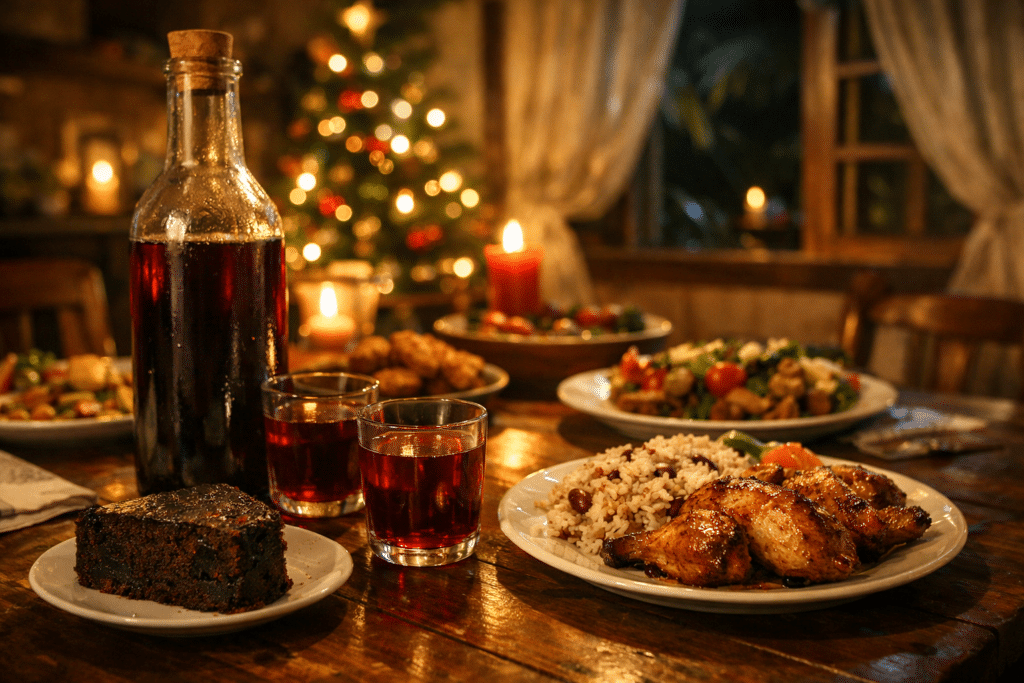
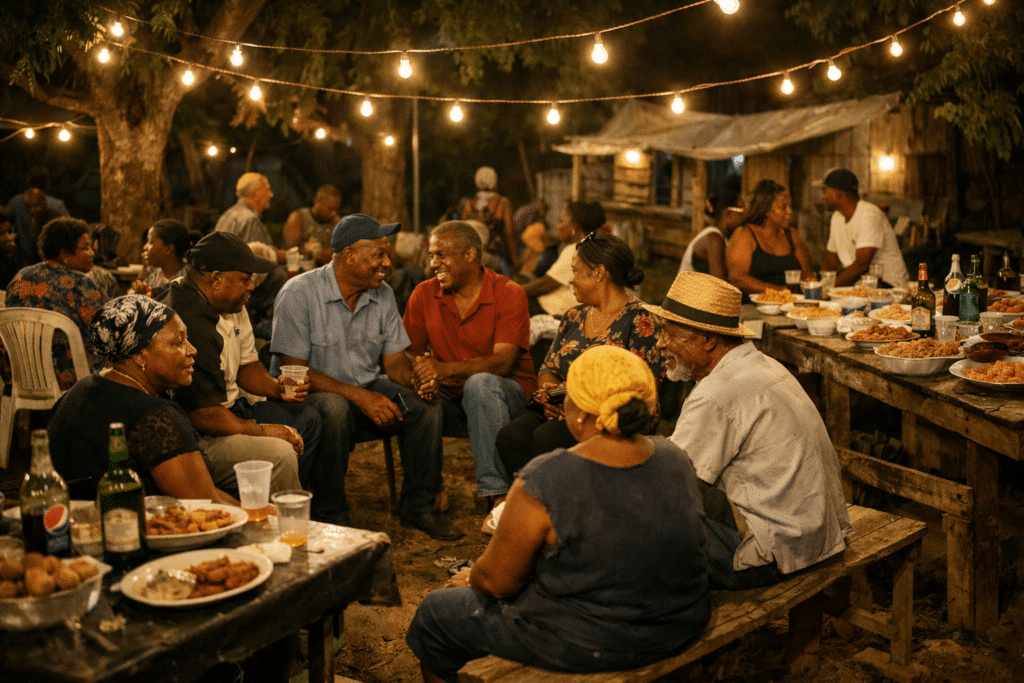
The Nine Nights tradition is Jamaica’s most enduring death ritual — and it is very much alive. For nine nights after a person dies, family and friends gather at the home of the deceased. There is food, rum, singing, storytelling, laughter, and yes, mourning. The gathering does two things: it honours the life of the person who passed, and it keeps the duppy company so it doesn’t feel abandoned and become restless. On the ninth night, the duppy is sent off properly — farewell given, peace made, the spirit encouraged to move on.
This is not morbid. In many ways it is the most human response to death imaginable — you don’t leave your people alone.
Duppy Church
One of the most striking beliefs in Jamaican folklore. In the deep quiet of late night — usually around midnight — some people say you can hear it. Hymns. A congregation singing. The murmur of a preacher. A full church service, complete and clear.
But when you go to find it, there is nobody there.
It is the duppies holding their own service. Continuing, in death, the rituals they practiced in life. The warning is firm and consistent across every version of this story: do not follow the sound. Do not investigate. Do not go toward it.
The Woman in White
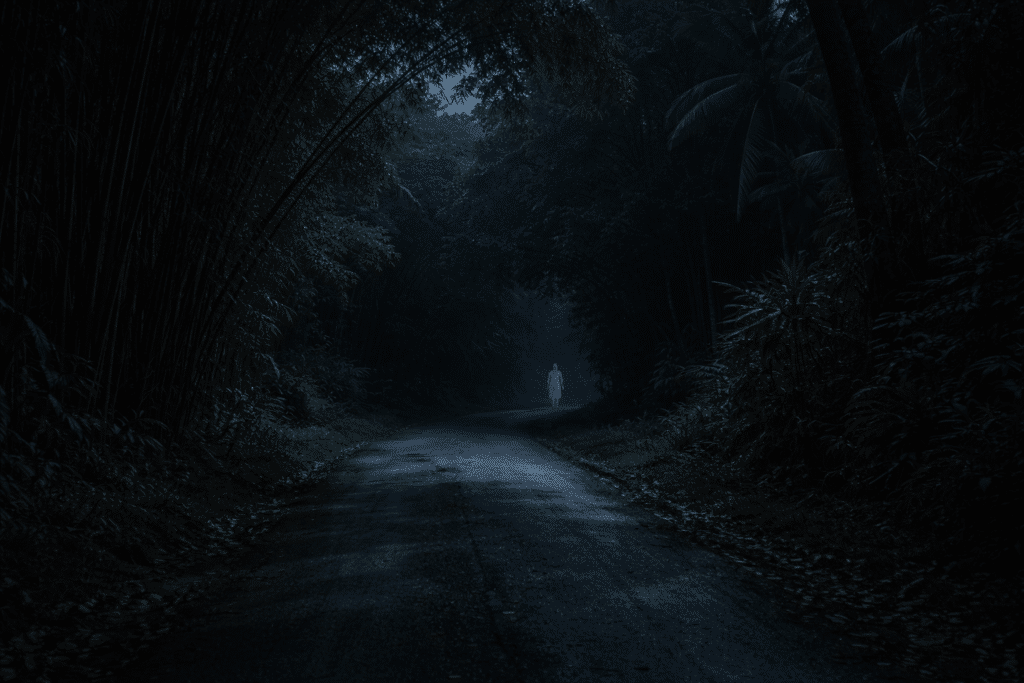
Every taxi driver in rural Jamaica knows this warning. Late at night, on a dark country road, a woman standing alone. Dressed in white. Waiting.
Don’t stop.
In Jamaican tradition the dead are often buried in white, and white on a dark road after midnight is one of the clearest signals that what you’re seeing is not of this world. Crossroads feature heavily in these stories — and that is not a coincidence. Crossroads in West African spiritual tradition are liminal spaces, the meeting point between the world of the living and the world of the dead. That belief crossed the Atlantic and took root in Jamaica.
The Cotton Tree
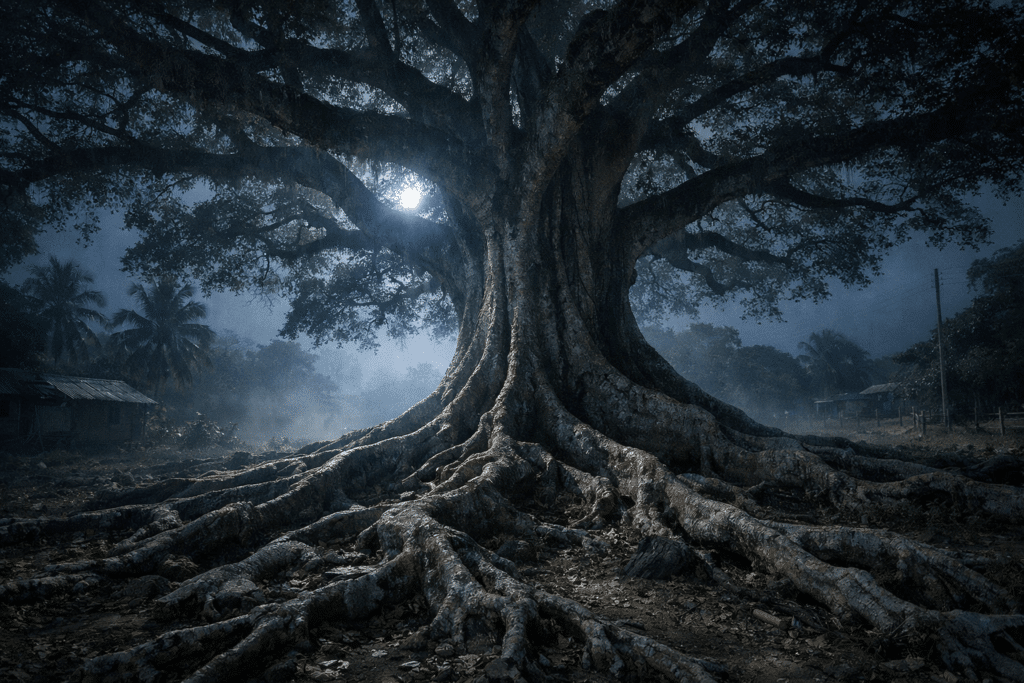
Duppies live in cotton trees. This is not a metaphor. If there is a large old cotton tree near a yard, the older generation will give it a wide berth after dark. The roots of the cotton tree are where spirits gather. You don’t lean on it. You don’t disturb it. You give it its due respect and you walk on.
How to Handle a Duppy
If one is following you, here is what generations of Jamaican wisdom say to do:
- Turn your clothes inside out — it confuses the duppy and breaks the trail
- Drop stones, matches or sticks along the road behind you — duppies can only count to nine
- Mark an X on the ground — for the same reason
- Place 10 coffee beans in the room — for the same reason, they will try to count to 10 and never manage it
- Plead the blood of Jesus — and if that’s not enough, remind it that it contributes nothing to the household expenses
The Everyday Ones: The Rules You Grew Up With
Not everything is death and duppies. Much of Jamaican superstition lives in the ordinary moments — getting dressed, sweeping the floor, opening an umbrella, letting a lizard land on you.
- Open an umbrella indoors and you will never get married. This one may not be originally Jamaican — it appears in British folklore too, likely carried over through colonialism and absorbed into the culture. But in Jamaica it took on its own life and it is said with the same authority as every other warning. Don’t test it.
- “Don’t sweep a night, it cause crosses.” Sweeping the house after dark invites bad luck in. You’re sweeping goodness out along with the dust. Wait until morning. The floor will still be there.
- Burn your hair so nobody can work obeah on you. After a haircut or after combing out loose hair — burn it. Don’t leave it on the floor or in the bin. If someone finds your hair, they can use it to work obeah on you. Granny was not playing about this one. The hair goes in the fire.
- Your left eye starts twitching uncontrollably. In Jamaica, this is not a medical symptom. Someone is talking about you. Gossiping. Spreading your business. Your right eye jumping means something good is coming. But the left? Go find out who’s been chatting.
- Bird droppings on you means money coming. Counterintuitive and deeply inconvenient, but the belief is firm. One exception: if it’s a John Crow — the turkey buzzard — the rules change entirely. A John Crow is an omen of death. There is no silver lining there.
- Large moths are called “Duppy Bat” in Jamaican parlance. If one lingers around a particular person or enters the house, it is believed a duppy has come in that form — usually a recently deceased relative checking in on the family. Some people are genuinely terrified. Others acknowledge it, say a quiet word to whoever passed, and leave the light off so the moth moves on
New Life: Birth & Pregnancy Beliefs
Jamaican superstition doesn’t wait for you to be born. The beliefs start before you arrive and the rituals begin the moment you do
The Navel String Tree
After a baby is born, the umbilical cord — the navel string — must not be allowed to fall on the floor. Within three days to a year of birth, it is buried in the ground and a tree planted in that spot. That becomes the child’s navel string tree — a living marker of where they came from, tied to the land itself.
As the tree grows and blossoms, it is said to reflect the child’s future success. If the tree is ever destroyed, the child must be compensated. If the land is sold, a sucker from the original tree must be brought to the new property and planted there. The roots travel with the family.
This is not just superstition. It is one of the most beautiful expressions of what it means to belong somewhere.
Food Cravings and Birthmarks
If a pregnant woman has a craving she cannot satisfy and scratches her body in that moment, the baby will be born with a birthmark on the same spot — shaped like the food she was craving. Craving mango and scratch your shoulder? The baby carries a mango-shaped mark. Many Jamaicans can point to their own birthmark and tell you exactly what their mother was craving that day.
The Lizard Test
Before pregnancy tests. Before missed periods. There was the lizard. If a lizard jumps on a woman, someone near her is pregnant — maybe her, maybe her sister, maybe her closest friend. The household immediately begins asking questions. The lizard, meanwhile, has already moved on.
Rice Water and Duppies
Wash your face with the water rice was rinsed in and you will be able to see duppies — spirits that are normally invisible to the naked eye. The same is said of using the matter from a dog’s eye. Most Jamaicans hear this and make a deliberate decision never to try it. Some things are better left unseen.
Blessing the Space: Where Faith and Folklore Meet
Not everything in Jamaica’s spiritual world is about protection from something dark. Just as much of it is about actively inviting goodness in — consecrating spaces, covering activities, and making sure that nothing of significance begins without God being acknowledged first.
In Jamaica, the line between religious practice and superstition was never clearly drawn. And that is not confusion. That is culture.
The House Blessing
You do not move into a new home in Jamaica without blessing it first. Full stop. The pastor comes, the family gathers, and every room is prayed over — the bedroom, the kitchen, the front door, sometimes the yard. You are doing two things at once: claiming the space for the living and for God, and making it very clear to anything that was there before that it is time to move on.
This extends beyond homes. A new car gets prayed over. A new business. A new venture of any kind. The spiritual covering comes before anything else. Whether that means pouring white rum at the four corners of the foundation or calling the pastor for a dedication service — the impulse is identical. The roots run in the same direction.
The Open Bible
In many Jamaican homes, a Bible sits open in the bedroom or near the front door. Not closed on a shelf. Open. Most often turned to Psalm 91. This is not decoration. The Bible is present as an active force. A standing guard. There is a specific version many Jamaican mothers practice for newborns — Psalm 23 placed open near the baby’s crib. For a baby, whose eyes already seem to be watching something you cannot see, you put the most comforting, most protective psalm you know close to their head. It is both faith and protection in one gesture. The same logic as the bush tea granny brewed — except here the barrier is scripture, and the authority is considerably higher.
Everything Starts with Prayer
School assembly. Work meeting. Community gathering. Nine Nights. In Jamaica, virtually every gathering of people begins with a prayer. Not as formality. As foundation. A meeting that starts without prayer feels structurally wrong to a Jamaican. Something is missing. You haven’t acknowledged who is ultimately in charge of how this goes. It would be like pouring the foundation without the rum — technically possible, but you’ve left something important undone.

Which Number Dat Inna Cash Pot?
Something happens. Good or bad. A strange dream. A bird flies into the house. A dog howls at nothing. Someone passes away. An owl screeches three times over the roof.
A Jamaican processes all of this and then asks: “Which number dat inna Cash Pot?”
Cash Pot is a daily numbers lottery where every number from 1 to 36 has a corresponding meaning — a dream symbol, an animal, a person, an event, a spiritual sign. Dream about a fish? That’s a number. Lizard jumped on you? Number. Duppy visited you in the night? Absolutely a number, and probably worth playing.
What makes Cash Pot remarkable is that, it didn’t invent these meanings. The meanings already existed — in the folk beliefs, the dream interpretations, the superstitions passed down through generations. Cash Pot simply attached numbers to a belief system that was already deeply embedded in Jamaican culture, and then monetised it.
Nobody else in the world has built a national lottery system on top of their folk beliefs. That is a uniquely Jamaican achievement, and it deserves to be celebrated as such.
And this is something no other article about Jamaican superstitions will tell you: in Jamaica, the spiritual sign is never just a sign. It is also potentially an opportunity. A duppy visit is unsettling, yes — but it is also information. Information has value. You take the sign seriously, you interpret it carefully, and then you go play your number.
This, too, is deeply Jamaican. We are not passive recipients of the universe’s messages. We extract every possible ounce of practical value from them. The duppy that visited you in the night is frightening — and it just paid for your groceries.
Africa Never Left Jamaica
To really understand Jamaican superstitions, you have to understand where they came from. When enslaved Africans were brought to Jamaica, they were stripped of nearly everything. Their names. Their languages, in many cases. Their freedom. But their spiritual world survived. The beliefs, the rituals, the understanding of how the living relate to the dead — these survived. They adapted, they blended with European Christianity and indigenous Taino traditions, and they became something uniquely Jamaican. But the roots are African. And they are deep.
You hear it in the Nine Nights tradition — the gathering to keep company with the recently dead, the rum, the sending-off. That practice traces directly to West African funeral customs where the dead are honoured and actively guided out of the world of the living.
You see it in the libation — the rum poured on the ground. When you pour for the fallen, you are saying: you are still here with us. You are not forgotten. You get your share. You see it today every time someone tilts a cold beer and lets the first pour hit the ground before they take a sip. These Jamaican superstitions are based on ritual is thousands of years old. The bottle is just the latest vessel.
And you hear it in the simplest, most everyday version of all — a Jamaican alone in a house, hearing a sound, addressing it directly. “Come out enuh. Cause yuh naah pay nuh rent in ya” That is not fear. That is a person standing in their own authority. That kind of confidence with the supernatural doesn’t come from nowhere. It came from a people who were never, even in the worst conditions imaginable, spiritually abandoned. Their ancestors were with them. They still are. You can read more about how these values and traditions were carried and kept in Mi Granny Seh: The Matriarch & Keeper of Jamaican Culture.
Africa never left Jamaica. It just changed clothes.
Walk Good
Jamaican superstitions are not just old-time stories — they are a record of how Jamaicans have understood life, death, and the unseen world for generations. Jamaica is a place where the visible and invisible worlds have always lived side by side. Where you can plead the blood of Jesus and pour rum for the dead in the same afternoon and see no contradiction whatsoever. Where a granny’s warning about a lizard or a dog’s howl at night carries the weight of generations behind it.
These beliefs are not relics. They are not primitive. They are a living archive — the spiritual memory of a people who built something extraordinary out of the most brutal of circumstances, and who never let death, or distance, or time, fully sever their connection to what came before.
Some of us still plead the blood.
Some of us still burn our hair.
Some of us still pour a little rum on the ground when we lose someone.
And some of us still don’t pick up lone women in white on dark country roads after midnight.
You know why.
Keep Exploring Jamaican Culture
- Mi Granny Seh — The Jamaican Grandmother Who Shaped Us All
- Jamaican Duppy Stories — The Ones That Still Give Us Chills
- Jamaican Proverbs: The Wisdom Granny Left Behind
- Bush Tea & Blessings — Jamaica’s Natural Medicine Cabinet
What superstitions did you grow up with?
Drop your granny’s warnings in the comments — the ones that aren’t on this list. You might just be preserving something the internet hasn’t documented yet.
Walk good. 🇯🇲
Every Nook. Every Cranny. All Jamaican.