
The dishes every visitor must try and every Jamaican already loves (well almost).
Jamaican food is not a side note to the Jamaican experience — it is the experience. From the smoky hillside pits where jerk chicken has been slow-cooking for generations, to the roadside vendors balancing trays of steaming patties, to the grandmothers who still make their pepper sauce from a recipe no one ever wrote down — every bite tells a story.
This is not a list of dishes you’ll find on a resort buffet. This is the real thing: 32 foods rooted in history, culture, and an island that has always known how to eat well. Some you’ll find everywhere. Some you’ll have to search for. All of them are worth it.
Ready? Let’s eat.
🇯🇲 Before we dive in — if you’re visiting Jamaica soon or just want to connect with the culture, grab the free Talk Like a Jamaican pocket guide. Slangs, proverbs, bush tea, and yes — the badwords. All Jamaican. Drop your email below and it’s yours.
What Is Jamaican Food Known For?
Jamaican food is known for bold seasoning, scotch bonnet pepper heat, and dishes deeply rooted in African, Taíno, Indian, and colonial influences. Signature dishes include jerk chicken, ackee and saltfish (the national dish), curry goat, oxtail, rice and peas, and the Jamaican beef patty. The food is eaten everywhere — from fine restaurants to roadside cook shops — and the best versions are almost always found away from the tourist strip. In fact, if you really want to eat well in Jamaica, start by ditching the all-inclusive resort altogether.
The Classics — Foods Every Jamaican Grows Up With
01. Ackee & Saltfish
Jamaica’s national dish. Non-negotiable.
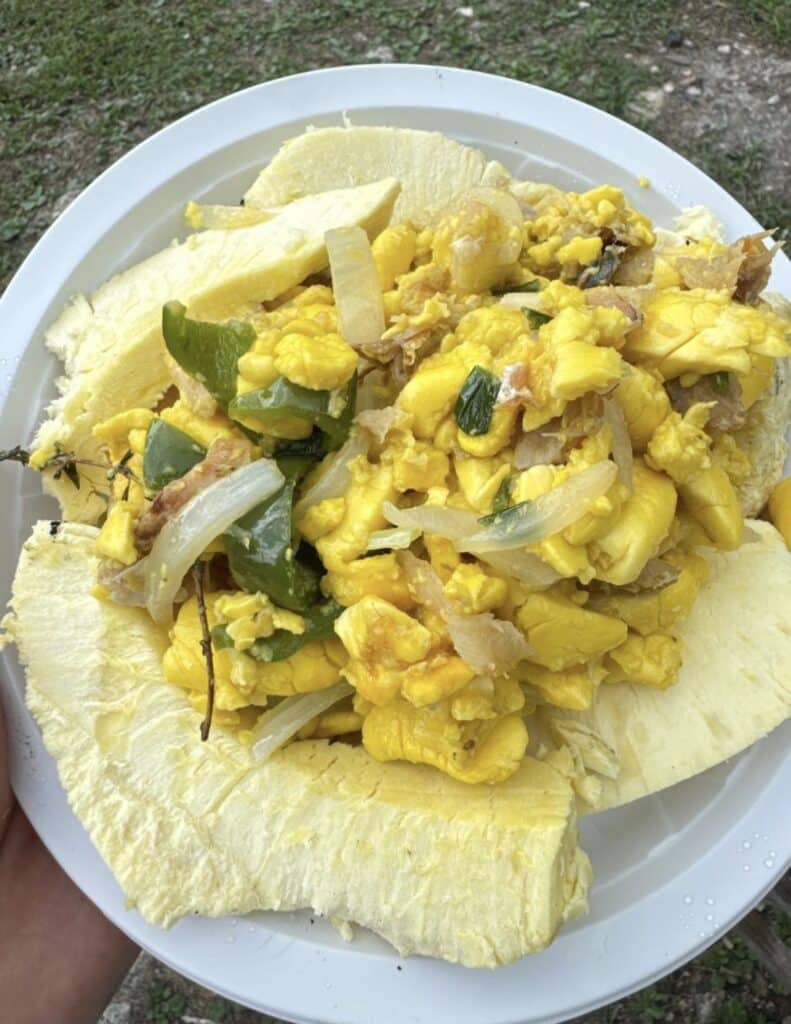
If you do nothing else, eat this. Ackee — a fruit that arrived in Jamaica from West Africa in the 18th century — is sautéed with salted codfish, onions, scotch bonnet pepper, and thyme until it resembles scrambled eggs in the most delicious way imaginable. It’s traditionally a breakfast dish, but Jamaicans will tell you there’s no wrong time for it. The texture is buttery, the flavour is savoury and layered, and nothing else on earth tastes quite like it.
Ackee and saltfish deserves more than a paragraph — we gave it a full article. The history, the preparation, and why it earned its place as Jamaica’s national dish.
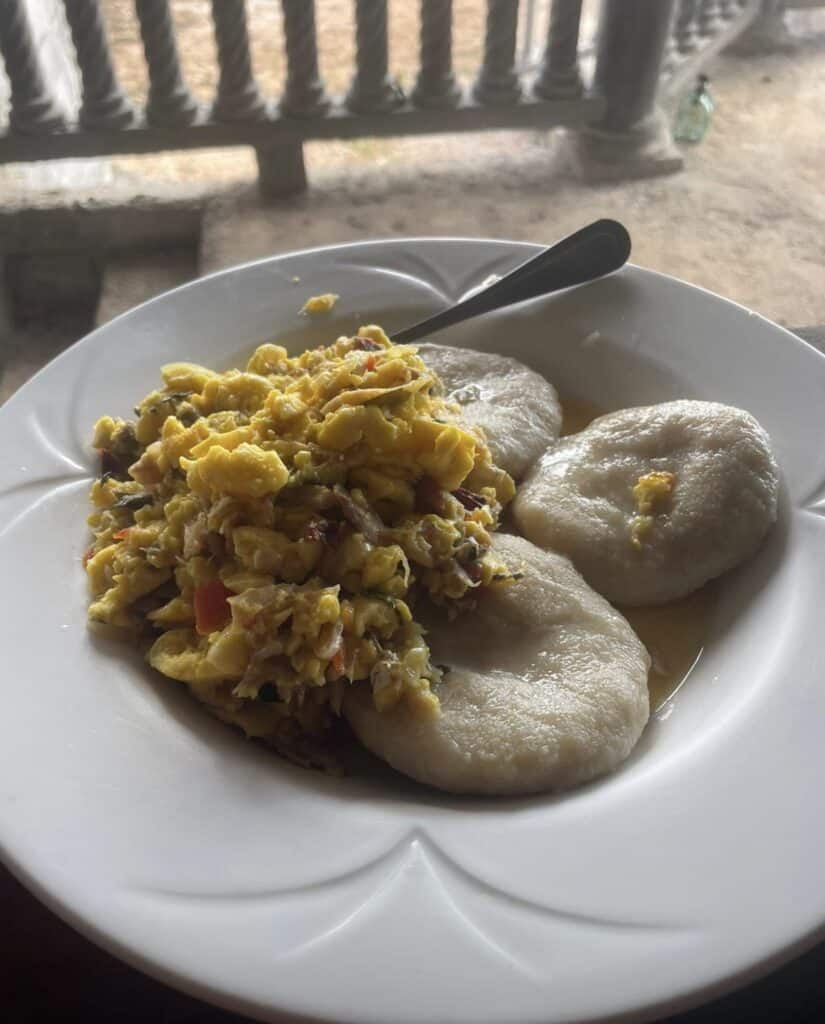
Where to Find It: Any Jamaican cook shop for breakfast. For the best versions, ask locals — the greatest ackee and saltfish is always someone’s grandmother’s recipe.
02. Jerk Chicken
One of the dishes that helped put Jamaica on the global culinary map.
Jamaican Jerk is not a sauce. It’s not a spice rub you buy in a bottle. It’s a tradition — a centuries-old cooking method born from the Maroons of Jamaica’s Blue Mountains, who slow-cooked wild boar over pimento wood to preserve it during their resistance against British colonial forces. Today, jerk chicken is marinated in scotch bonnet peppers, allspice (pimento), thyme, garlic, and ginger, then cooked low and slow over a pimento wood fire. The result is smoky, spicy, fragrant, and deeply flavourful in a way no oven can replicate.
Where to Find It: Scotchies in Ocho Rios or Montego Bay is the gold standard for visitors. But the best jerk you’ll ever eat is probably at a roadside drum pan on a country road at 11pm
03. Jerk Pork
The original jerk. Before the chicken, there was the pork.
Jerk chicken may be what tourists order, but among Jamaicans, jerk pork is the purist’s choice — and historically, it came first. The Maroons of the Blue Mountains originally jerked wild boar, not chicken, and pork remains the most intensely flavoured expression of the jerk tradition. Shoulder or belly cuts are marinated overnight in a fiery blend of scotch bonnet, allspice, thyme, and garlic, then cooked low and slow over pimento wood until charred on the outside and impossibly juicy within.
Insider Tip: At a jerk pit, always ask if they have pork. Many spots sell out early. The crackling skin alone is worth the trip.
04. Jamaican Beef Patty
The greatest handheld food in the Caribbean. Possibly the world.
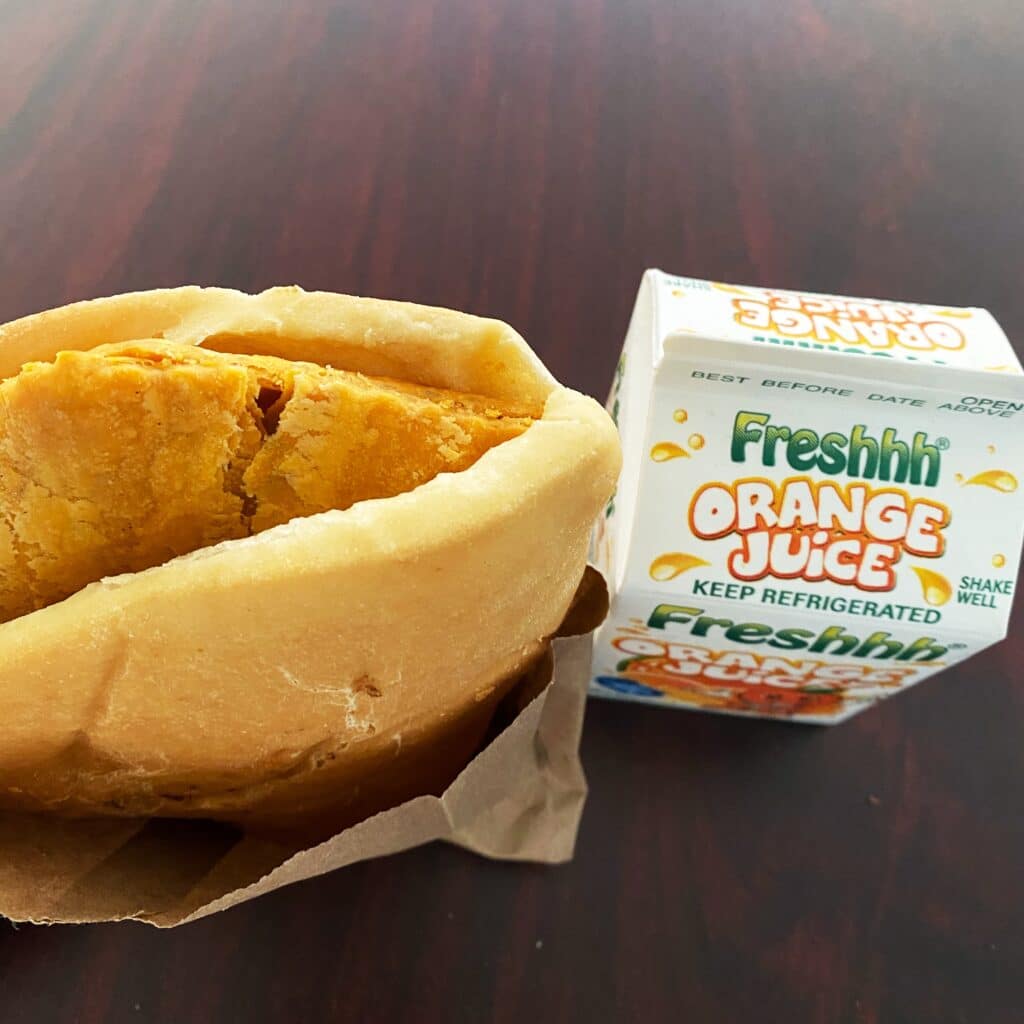
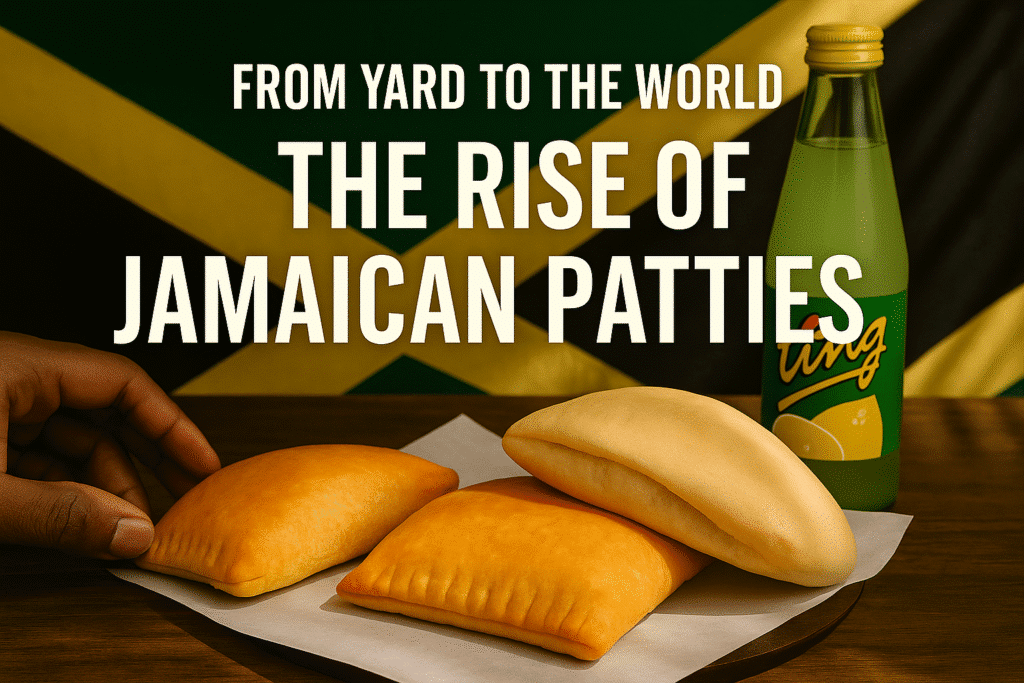
A flaky, turmeric-gold pastry shell encasing a perfectly seasoned minced beef filling — the Jamaican patty is what happens when British pasty-making traditions meet the scotch bonnet pepper and a century of culinary refinement. It costs next to nothing, you can find it everywhere, and it is dangerously addictive. Often eaten with a coco bread folded around it like a sandwich. Variations include chicken, vegetable, lobster, callaloo, and cheese.
The patty deserves its own story — and we gave it one. Go read it.
Pro Tip: Get it from a proper patty shop or bakery — Tastee and Juici Patties are institutions. The ones from a hot glass case in a local shop are transcendent.
05. Rice & Peas
Sunday dinner. Every Sunday. Without exception.
Don’t be fooled by the name — the ‘peas’ are kidney beans (or gungo peas, depending on the season and the cook), and this is rice like you’ve never had it. The rice and peas are cooked together in coconut milk with thyme, garlic, and scotch bonnet, creating a dish that is simultaneously simple and complex. In Jamaica, Sunday without rice and peas is not really Sunday. It is the foundation upon which the rest of the plate — jerk chicken, oxtail, curry goat — is built.
Cultural Note: Ask a Jamaican about their mother’s rice and peas recipe and prepare for a 20-minute passionate explanation of why no one else makes it correctly.
06. Oxtail
Low and slow. Fall-off-the-bone perfection.
Oxtail is patience in food form. The tail of the cow, braised for hours in a rich, dark sauce of butter beans, scotch bonnet, allspice, and browning until the meat collapses and the gravy becomes something close to magic. Served over white rice or rice and peas, it is the kind of dish that makes you close your eyes after the first bite. This is comfort food at its most profound.
Where to Find It: Any proper Jamaican restaurant. At a good cook shop on a Friday or Saturday. In someone’s kitchen if you’re very lucky.
07. Curry Goat
The centrepiece of every celebration.
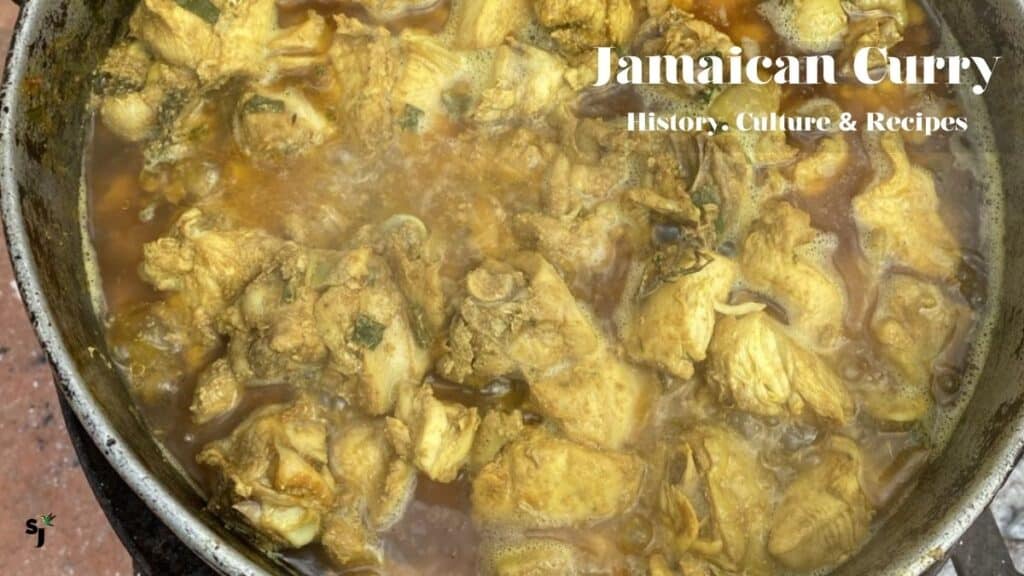
No Jamaican wedding, christening, birthday, or nine-night is complete without a pot of curry goat. Slow-cooked in a fragrant blend of Jamaican curry powder, scotch bonnet, thyme, and allspice until the bone-in pieces are meltingly tender, this is deeply aromatic and warming food with roots in the Indian indentured workers who arrived in Jamaica in the 19th century and left an indelible mark on the island’s culinary identity.
Cultural Note: The communal act of cooking curry goat — stirring a massive pot over an open fire — is itself a social event. If you’re ever invited to one, don’t decline.
08. Stew Chicken
The weeknight hero of every Jamaican household.
Jerk gets the glory, but stew chicken is what Jamaicans actually cook on a Tuesday. Chicken pieces marinated in browning, garlic, thyme, and scotch bonnet, then slow-cooked in a rich, dark, aromatic gravy until the meat is falling-tender and the sauce has reduced into something deeply savoury and complex. Served with white rice or rice and peas, it is the definition of comfort food — unpretentious, reliable, and quietly one of the best things you’ll eat in Jamaica.
Cultural Note: Every Jamaican cook has their own browning ratio and marinating time. Arguments about whose stew chicken is best are entirely normal and never fully resolved.
09. Saturday Soup — Red Peas, Chicken Foot & Pumpkin
Not just a meal. A weekly Jamaican institution.
In Jamaica, Saturday means soup — full stop. The pot goes on in the morning and the whole house smells of thyme, scotch bonnet, and pimento long before lunchtime. Red peas soup is the king: thick, hearty kidney beans slow-cooked with salted pig tail, yam, cho cho, and hand-rolled spinners in a broth so rich it coats the back of a spoon. Chicken foot soup brings collagen-rich depth and a silky, restorative warmth that is deeply and unmistakably Jamaican. The pumpkin goes in the pot too — it bleeds that deep golden colour into the broth and adds a natural sweetness that makes the whole thing sing, In Jamaica, soup is medicine. Sick? Soup. Tired? Soup. Heartbroken? Soup. No Jamaican grandmother has ever accepted ‘I’m not hungry’ as a valid response when there is a pot on the stove.
Saturday Tip: Find a local cook shop or family restaurant on a Saturday around lunchtime. The pot will be on. Get a bowl — whichever variation they’re serving, you won’t regret it.
Street Food — The Real Flavour of the Island
10. Festival
The underrated hero of the Jamaican plate.
A slightly sweet, fried dumpling made from cornmeal and flour — golden, crispy outside, soft inside — festival is the perfect companion to jerk chicken or fried fish. The name is said to come from the festive feeling it brings, and that tracks. It’s simple food done with pride, and it elevates everything it sits next to on the plate.
11. Bammy
Cassava flatbread with 3,000 years of history.
Long before Columbus arrived, the Taíno people of Jamaica were making bammy — a thick, round flatbread made from grated cassava. It’s been on this island for millennia. Today it’s soaked in coconut milk and fried or steamed, and served alongside fried fish. It has a chewy, slightly dense texture that soaks up sauces beautifully. Eating bammy is eating pre-colonial Jamaica.
🌿 History Tip: Bammy is one of the few dishes with direct Taíno heritage that survived colonisation. That makes every bite a small act of cultural preservation.
12. Roast Corn & Roast Breadfruit
Roadside simplicity at its finest.
Drive through any Jamaican country road and you’ll find vendors roasting corn directly on coals — charred, smoky, and sweet in a way that supermarket corn can never match. Breadfruit (introduced to Jamaica by Captain Bligh in 1793, ironically from Tahiti) is roasted the same way: blackened on the outside, creamy and starchy within. Both are cheap, filling, and deeply satisfying.
13. Mannish Water
Not for the faint-hearted. Essential for everyone else.
Mannish water is a hearty goat-head soup — yes, the whole head — slow-cooked with green bananas, yam, scotch bonnet, and spices. It has a rich, gelatinous broth with an intense, earthy depth that you won’t find in any other soup. Jamaicans attribute it with restorative properties — it’s the dish that shows up at nine-nights and repass, when a community gathers to grieve and eat together, and the pot needs to be worthy of the occasion. Whether or not you believe the folklore, the flavour is undeniable.
14. Fried Dumplings
The Jamaican breakfast staple. Simple, golden, non-negotiable.
Made from flour, water, and a pinch of salt, fried dumplings are round, golden, crispy orbs that appear at breakfast alongside ackee and saltfish, callaloo, or saltfish and cabbage. They’re not complicated. They don’t need to be. They are Jamaican morning cooking in its purest, most essential form.
15. Saltfish Fritters (Stamp & Go)
Jamaica’s original fast food.
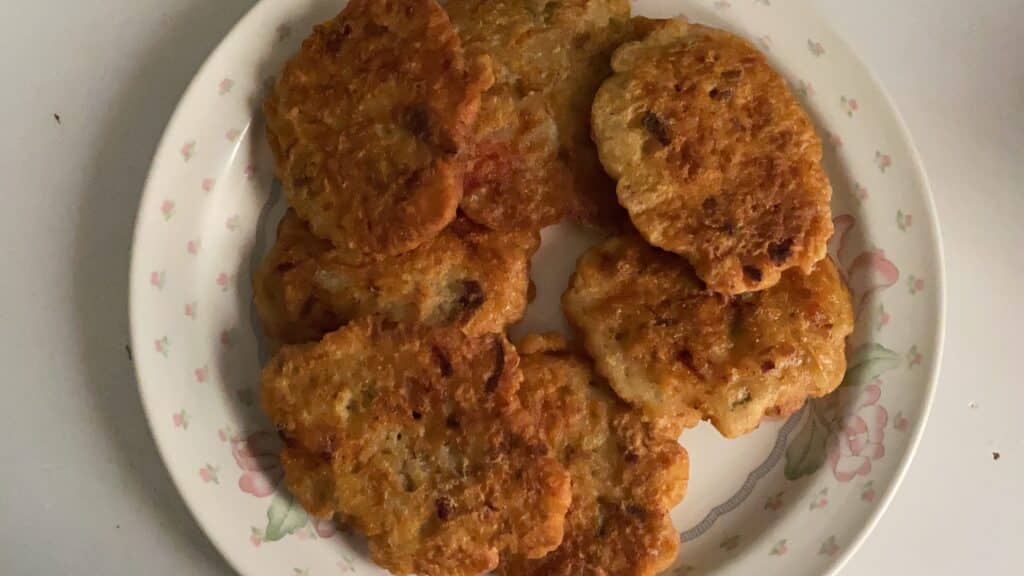
Small, round, pan-fried fritters made from saltfish, flour, scotch bonnet, and herbs — stamp and go are crispy, salty, and addictive. They’ve been a Jamaican street food staple for centuries and are one of the best things you can eat at a market or roadside stall. The name allegedly comes from the days when they were sold at harbour shops where sailors would ‘stamp’ their feet impatiently and demand to go.
From the Sea — Jamaica’s Fresh Catch
16. Escovitch Fish
Fried whole fish smothered in a tangy pickled vegetable sauce.
A whole snapper or parrot fish, seasoned, fried crispy, then topped with a vibrant escovitch sauce — sliced onions, carrots, scotch bonnet, and vinegar — that has been pickling in its own heat. The contrast of the crispy fish and the sharp, spicy sauce is electric. Escovitch is a dish with Spanish-Jewish roots, brought to Jamaica centuries ago and made entirely Jamaican in the process. It’s also one of the centrepieces of the Jamaican Easter table — along with bun and cheese, it’s the Good Friday food.
It features in our guide to Jamaican Easter traditions — if you want to understand what Good Friday really looks like on the island.
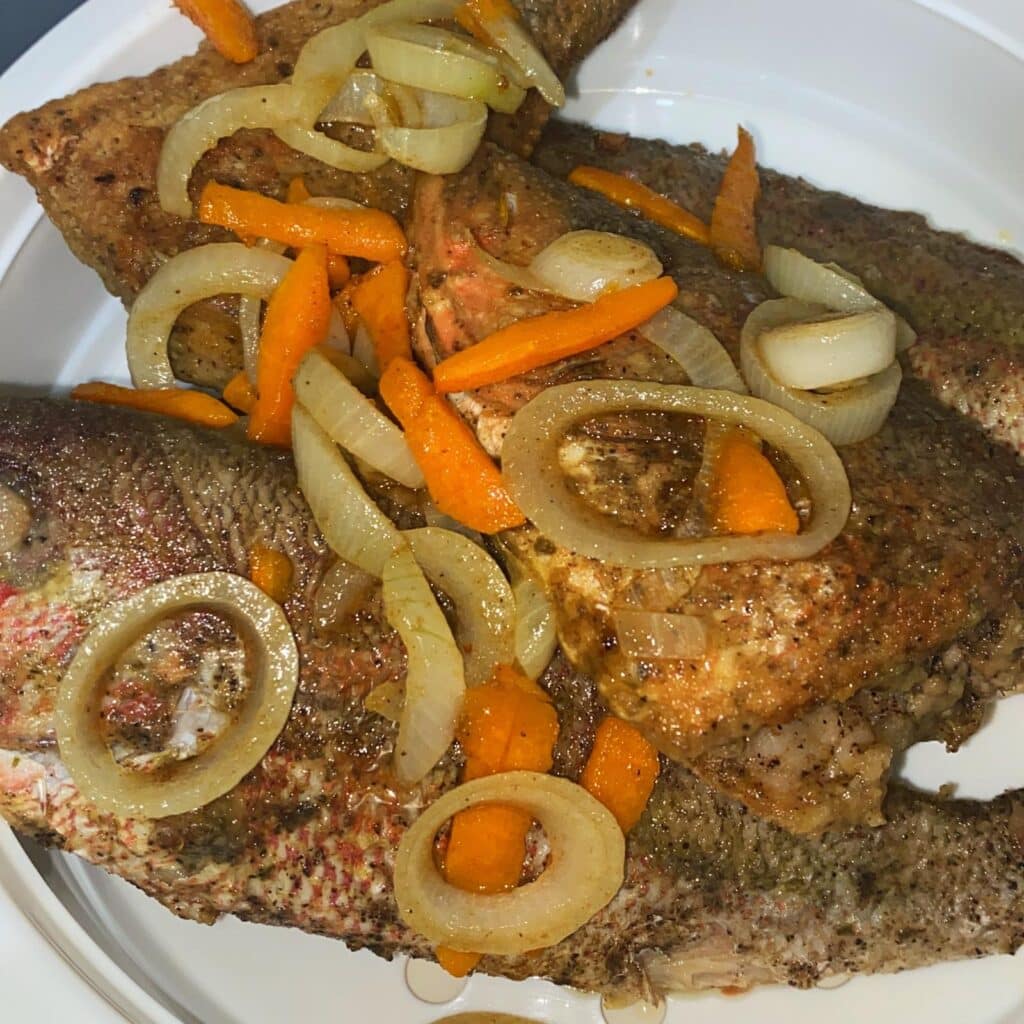
🐟 Where to Find It: Any coastal fish market or roadside seafood spot. Port Royal — the old pirate city just outside Kingston — is one of the best places in Jamaica to eat escovitch fish.
17. Roast Fish with Callaloo, Crackers & Okra
The coastal Jamaican meal that tourists almost never find — and locals swear by.
This is seaside Jamaica on a plate. A whole snapper or parrot fish, seasoned with garlic, scotch bonnet, and herbs, then stuffed with callaloo and wrapped in foil before going on the coals. The fish roasts in its own steam, the callaloo wilting into the flesh, the flavours merging until the skin blisters and everything inside is tender and fragrant. Served with boiled okra and tough crackers to scoop it all up. Simple, fresh, and honest food that has fed Jamaican fishing communities for generations.
18. Pepper Shrimp
Middle Quarters. One of Jamaica’s greatest roadside traditions.
On the road between Mandeville and Savanna-la-Mar, in a tiny community called Middle Quarters in St. Elizabeth, women have been selling small, fiery, freshwater pepper shrimp from roadside buckets for generations. The shrimp are cooked in a blisteringly hot scotch bonnet broth, turning brilliant red and intensely flavoured. You buy them by the bag, peel them with your fingers, and eat them on the side of the road. It’s one of Jamaica’s most authentic and joyful food experiences.
🌶️ Fair Warning: These are genuinely, uncompromisingly hot. Be ready to embrace the fire.
Breakfast & Sides — How Jamaica Starts the Day
A quick note for our non-Jamaican readers — and yes, we see you side-eyeing the oxtail at breakfast.
Here’s the thing: in Jamaica, no food is off limits based on the time of day. If the pot from last night still has something in it, that’s breakfast. Leftover curry goat? Heat it up. We don’t let the clock tell us what we can eat. The only question that matters is: is there food in the house? Yes? Good. Eat.
If you want to go deeper on the Jamaican breakfast table, we broke down the top Jamaican breakfast dishes in a dedicated article.
19. Porridge
Pure comfort. Any time of day.
Jamaican porridge is not the plain oats of a rushed weekday morning. This is cornmeal porridge — thick, creamy, sweet with condensed milk and spiced with cinnamon and nutmeg — or peanut porridge, dense and nutty and filling in a way that keeps you going for hours. Hominy corn, plantain, or green banana porridge each bring their own character. All of them are served hot, usually with a pack of tough crackers on the side, and all of them are deeply, specifically Jamaican.
🍚 Cultural Note: Many Jamaicans will debate endlessly about which porridge is best. Peanut has a strong lobby. Cornmeal has tradition on its side.
20. Liver and Boiled Food
The cook shop breakfast that keeps you going all day.
Liver is one of those dishes that divides opinion — you either grew up eating it and love it, or you grew up eating it and have complicated feelings about it. But cooked the Jamaican way, it converts people. Beef liver, seasoned and sautéed down with onion, sweet pepper, garlic, and scotch bonnet until it’s tender and deeply savoury, served alongside boiled ground provisions — yam, green banana, and dumpling. It’s a serious plate. A working meal. The kind of breakfast that doesn’t require a mid-morning snack.
And if you’ve never had liver with fried dumplings — that dumpling soaking up the gravy — consider this your sign. That combination is in a category of its own.
21. Boiled Food — Yam, Green Banana, Dumpling & Ground Provisions
The backbone of the Jamaican plate.
‘Boiled food’ is the collective Jamaican term for boiled ground provisions — yam, green banana, coco, sweet potato, Irish potato, and dumplings. It sounds simple. It is simple. And it is indispensable. Boiled food is what callaloo and saltfish sits on. It’s what soaks up the liver gravy. It’s what fills you up before a long day’s work. Yellow yam, in particular, is creamy and rich in a way that will convert any vegetable sceptic.
22. Jamaican Herbal Teas
The island’s natural pharmacy. A cup of wellness in every sip.
Long before wellness culture made herbal teas fashionable, Jamaican grandmothers were brewing them with quiet authority. Cerasee — a bitter, bright green vine — is Jamaica’s most famous bush tea, drunk to cleanse the blood, aid digestion, and treat everything from skin conditions to high blood pressure. Fever grass (lemongrass) is soothing and aromatic, brewed for fevers and anxiety. Sarsaparilla is earthy and warming. Soursop leaf tea is believed to calm the nervous system. Peppermint tea is the one for belly ache and nerves — and it’s one of the most reached-for teas in any Jamaican household. “Fi yuh belly an fi yuh nerves — same cup,” as granny would say.
These teas are not sold in fancy packaging. They’re picked from yards and hillsides, boiled in a pot, sweetened with honey, and handed to you in a cup with the confidence of someone who has been doing this for fifty years. We covered some of Jamaica’s most trusted bush teas and what Jamaicans have been using them for — worth a read.
💛 Enjoying this guide? You’ll also want to Talk Like a Jamaican — our free pocket guide to Jamaican slangs, proverbs, bush tea, and a few words granny would wash your mouth out for. Free when you join the Showcase Jamaica community.
Ital & Vegetarian — From the Earth, Full of Life
Ital is the Rastafarian philosophy of living food — clean, natural, rooted in the earth. No meat, minimal salt, no preservatives. Cooked with intention. But you don’t have to be Rasta to appreciate Jamaican vegetarian food. The island grows so much — callaloo, breadfruit, yam, coco, plantain, pumpkin — that eating from the earth here is never a sacrifice. It’s a privilege.
23. Callaloo
Jamaica’s most beloved leafy green. On every table, in every parish.
If you grew up in a Jamaican yard, callaloo was just there. On the stove in the morning. Steaming down in the dutch pot on a Saturday. The smell of it sautéing with onion, sweet pepper, tomato, and scotch bonnet is basically a Jamaican alarm clock — one your body recognises before your brain catches up.
It shows up everywhere: steamed as a side, cooked with saltfish, folded into omelettes, stirred into rice, simmered into pepper pot soup. The most versatile vegetable on the Jamaican table — and in Ital kitchens, a foundation ingredient treated with the same respect as any centrepiece dish.
24. Ital Stew
Rastafarian living food. Roots, vegetables, coconut milk, and intention.
Ital stew is not a single dish — it’s a philosophy on a plate. A slow-cooked pot of whatever the earth is giving: callaloo, pumpkin, cho cho, yam, coco, breadfruit, plantain, and root vegetables, simmered in coconut milk with thyme, scotch bonnet, and pimento. No meat. No MSG. Often no salt — seasoned instead with herbs, coconut, and the kind of patience that makes food taste like it was cooked with purpose.
You’ll find Ital food at Rastafarian communities, certain health food spots in Kingston, and small roadside kitchens — particularly in the hills. It’s deeply satisfying, genuinely nourishing, and one of Jamaica’s most underappreciated culinary traditions.
Sweet Things & Drinks — The Jamaican Finish
25. Gizzada (Pinch-Me-Round)
A pastry shell filled with spiced coconut. Pure joy.
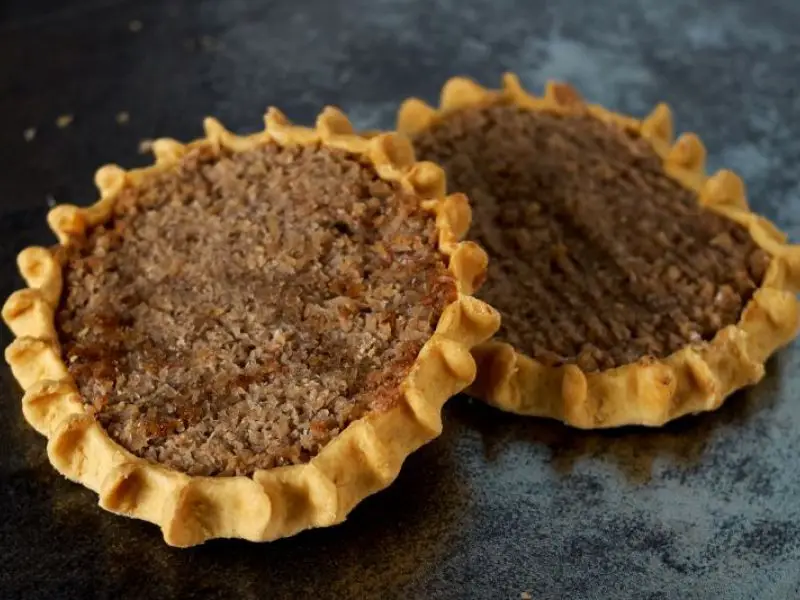
A small, open-faced tart with a pinched pastry edge — hence the nickname ‘pinch-me-round’ — filled with a sweet, dark mixture of grated coconut, brown sugar, nutmeg, and ginger. Gizzada has Portuguese roots, brought to Jamaica by Sephardic Jewish traders centuries ago and adopted wholesale into Jamaican baking culture. It is one of the island’s most beloved sweets and costs almost nothing.
26. Grater Cake
Pink and white. A childhood memory for every Jamaican.
Made from grated coconut and sugar cooked together and set into a firm, dense sweet — half pink, half white — grater cake is sold wrapped in cellophane at shops and markets across Jamaica. It’s unashamedly sweet, chewy, and intensely coconutty. For Jamaicans who grew up on the island or in the diaspora, one bite is an immediate transport back to childhood.
27. Devon House I-Scream
Kingston’s most iconic queue. Worth every minute of the wait.
Devon House is one of Kingston’s most historic properties — a 19th century mansion that has become a cultural landmark. But ask most Jamaicans why they go there and the answer is always the same: the ice cream. Devon House I-Scream is not ordinary ice cream. It is rich, dense, and deeply flavoured — particularly the rum and raisin, which has achieved something close to legendary status on the island. The queue outside the shop is a Jamaican institution in itself.
We have a full guide to Devon House — the history, the grounds, and yes, the ice cream — if you want the full picture before you visit.
Pro Tip: Go for the rum and raisin. If they’re out, get the coconut. Don’t leave without trying at least two scoops. The queue moves faster than it looks.

28. Rum Cake (Black Cake)
The crown jewel of Jamaican baking.
Jamaican black cake is a dense, dark, intensely flavoured fruit cake soaked — for months, in some recipes — in rum and red wine. The dried fruits (prunes, raisins, currants) are blended into a dark paste before baking, giving it an almost fudge-like richness. It is the centrepiece of every Jamaican Christmas table and wedding reception, and it is utterly unlike any fruit cake you’ve encountered before. A good Jamaican black cake can convert lifelong fruit cake sceptics.
29. Jamaican Rum Punch
Every Jamaican family has a rum punch recipe. Nobody agrees on the proportions. Everyone insists theirs is the right one. The general principle — sour, sweet, strong, weak — is about as close to a cultural law as Jamaica has. Made with proper Jamaican rum, fresh lime, and enough ice, it is bright, balanced, and dangerously easy to drink.
If you want to understand where the rum comes from, Jamaica has some of the best rum tours in the Caribbean. We covered them.
30. Sorrel
Jamaica’s Christmas drink. Spiced, spiked, and never enough in the bottle.
Made from the dried sepals of the hibiscus flower steeped with ginger, cloves, and cinnamon — and almost always spiked with rum — sorrel is a deep crimson, jewel-bright drink that appears at every Jamaican Christmas gathering. It’s tart, aromatic, warming, and festive in the truest sense. Increasingly, Jamaican producers are bottling it year-round, and the non-alcoholic version is just as good.
31. Blue Mountain Coffee
The most celebrated cup of coffee on earth.
Grown in the misty, mineral-rich soil of the Blue Mountains at elevations above 3,000 feet, Jamaica Blue Mountain Coffee is widely considered one of the finest coffees in the world — characterised by its clean, mild, almost sweet flavour with virtually no bitterness. It commands extraordinary prices in Japan and Europe, where most of the crop is exported. Drinking a cup on the island where it’s grown, looking out over the mountains it came from, is something you won’t forget.
☕ Where to Buy: Look for certified Blue Mountain Coffee at proper coffee shops and farms. Avoid cheap imitations in tourist gift shops — if it seems too cheap to be real Blue Mountain, it probably isn’t.
32. Wray & Nephew White Overproof Rum
Not just a drink. A Jamaican institution.
Wray & Nephew White Overproof Rum is 63% alcohol, clear as water, and smells like the soul of the island. It is the best-selling spirit in Jamaica by an enormous margin — not just because Jamaicans drink it, but because it lives in the kitchen too. It goes into the black cake at Christmas. It’s used to cure everything from a toothache to a cold. It’s splashed as a libation at celebrations. It fuels the dancehall and the nine-night and the Sunday cookout. Appleton Estate rum gets the international prestige and the export medals. Wray & Nephew White is what Jamaicans actually reach for. Treat it with respect — it demands it.
🥃 How to Drink It: Mixed with Ting (Jamaican grapefruit soda) over ice is the classic serve. A squeeze of lime. Don’t rush it. And do not, under any circumstances, try to match a Jamaican drink for drink on this particular rum.
Honourable Mentions — Too Good to Leave Out
These didn’t make the numbered list — not because they’re less worthy, but because Jamaica’s food culture is simply that rich. Consider this your extended bucket list.
✦ Stew Peas
The dish with a reputation. You’ve been warned.
Stew peas is a deeply comforting, slow-cooked pot of kidney beans, salted pig tail, coconut milk, and spinners, simmered until the broth is thick, rich, and almost impossibly flavourful. Served over white rice, eaten with a big spoon. But here’s where it gets interesting. In Jamaican folklore, stew peas carries a reputation that goes well beyond the dinner table. It is widely believed — and fiercely debated — that a woman can use this dish to ‘tie a man’: to cook something of herself into the pot, spiritually or otherwise, and bind his affections permanently. Whether you believe the folklore or not, one thing is certain: a good stew peas will absolutely make you want to come back.
⚠️ Fair Warning: If someone cooks stew peas especially for you, unprompted, you may want to ask a few questions first. Or don’t. Sometimes it’s better not to know.
✦ Saltfish & Roast Yam
Humble ingredients. Extraordinary results.
This is one of Jamaica’s most quietly beloved combinations — and one that rarely makes it onto tourist menus. Yellow yam (or sweet potato) roasted in its skin directly over coals until the outside is charred and the inside is creamy and sweet, served alongside sautéed saltfish with onion, tomato, and scotch bonnet. A dish rooted in resourcefulness — salt-preserved fish and a starchy root that grows abundantly on the island — elevated by the kind of instinctive seasoning that Jamaican cooks do without thinking.
🍠 Where to Find It: Country cook shops and roadside vendors, particularly in rural parishes. This is local, unpretentious eating at its very best.
Cabbage & Saltfish
Simple. Underrated. Very Jamaican.
Cabbage and saltfish doesn’t get the attention it deserves — probably because it looks too simple to be special. Shredded cabbage sautéed down with flaked saltfish, onion, sweet pepper, scotch bonnet, and thyme until everything is soft and fragrant and coated in its own seasoning. It’s a yard dish, a cook shop dish, the kind of thing that appears on a plate without fanfare and disappears just as quietly. Served with boiled dumplings or boiled food, it is one of those quiet Jamaican combinations that earns its place every time.
Curry Chicken
Curry goat gets the glory. Curry chicken feeds the island.
Curry goat is the centrepiece at celebrations — but curry chicken is what Jamaicans eat on a regular Tuesday. The same Jamaican curry powder, the same scotch bonnet and thyme, but cooked faster and more forgiving than goat. At a cook shop for lunch, a hot plate of steamed white rice with curry chicken on top and the gravy soaking into every grain is one of the most satisfying meals on the island. The fry dumpling version at breakfast — that dumpling soaking up the curry gravy — is in its own category entirely. And if curry is on the menu, more than a few Jamaicans will ask for some of the gravy poured over their rice regardless of what else is on the plate.
Box Food
The real Jamaican lunch. Rice and peas, a protein — stew chicken, curry goat, brown stew fish whatever the cook shop made that day — raw veg on the side. All in a styrofoam box. You wait your turn, you call your order — fried chicken, rice and peas, curry gravy on top — and you wait for it to be packed up hot and handed to you. This is how most working Jamaicans eat lunch every single day. No menu, no waiter, no reservation. Just good food, fast, and gone.
Jamaican KFC
Not international fast food. A Jamaican institution. Jamaica’s relationship with KFC is unlike anywhere else on earth. Friday night, after church on Sunday, late night after a dance — KFC is woven into Jamaican life in a way that can’t be explained, only experienced. And what makes it distinctly Jamaican is the BBQ — that flavour hits different on the island. Jamaicans navel string cut right there. We’re not here to judge. We’re here to document the culture as it actually is.
One Island. A Thousand Flavours.
Jamaican food is the story of the island itself — its African roots, its Taíno origins, its colonial history, its Indian and Chinese influences, its Maroon spirit, and its unshakeable sense of pride. Every dish on this list carries that history in every bite.
You don’t need a five-star restaurant to eat extraordinarily well in Jamaica. You need a willingness to follow your nose, trust a local recommendation, and order from the woman with the biggest pot and the longest queue. That’s always the right call.
If you’re planning your first trip and want to know what to expect beyond the plate, our guide to staying safe in Jamaica is a good place to start.
Which Jamaican food dish are you most excited to try? Drop it in the comments — and if you’ve already ticked some of these off your list, we want to hear about it.
Now Learn to Talk Like a Jamaican
You’ve got the food. Now get the language.
Talk Like a Jamaican is a free pocket guide covering everything you need to hold your own on the island — everyday slangs and expressions, Jamaican proverbs straight from granny’s mouth, bush tea remedies that have been curing Jamaicans for generations, and a respectful education in the badwords you’re going to hear whether you’re ready or not.
Join the Showcase Jamaica community, get the guide free, and be the first to know when new articles drop.
Walk good. 🇯🇲
Every Nook. Every Cranny. All Jamaican.
Pingback: Top 6 Jamaican Breakfast Items - Showcase Jamaica