Introduction
Somewhere between a Kingston corner shop and a Portmore domino table, Jamaican language is happening in real time — and if you don’t know the words, you’re going to miss most of the conversation.
Jamaican slang isn’t decoration. It’s the thing itself. The phrases carry history, humour, attitude, and identity all at once. You can’t fully understand a Jamaican conversation by looking up the words in a dictionary, because half the meaning lives in the delivery, the timing, and the relationship between the people talking.
But you have to start somewhere. This is that start.
Wha Dem Seh covers 38 of the most used Jamaican slang words and expressions — the ones you’ll hear from the airport to the yard, from the dance to the roadside stall. Each one comes with its meaning, a real usage example, and the cultural context that tells you not just what it means, but why it matters.
Why Jamaican Slang Matters
Jamaican slang carry traces of West African languages, colonial English, Rastafarian philosophy, and the everyday creativity of people who have always had a gift for making language do more work than it looks like it should.
Learning even a handful of these expressions does something that no guidebook can do for you — it signals that you’re paying attention. Whether you’re visiting Jamaica, part of the diaspora, or just deep in the culture through the music, knowing what people are actually saying changes how you experience it.
Greetings and Everyday Talk
These are the words you’ll hear from minute one. Learn these and you’re already ahead
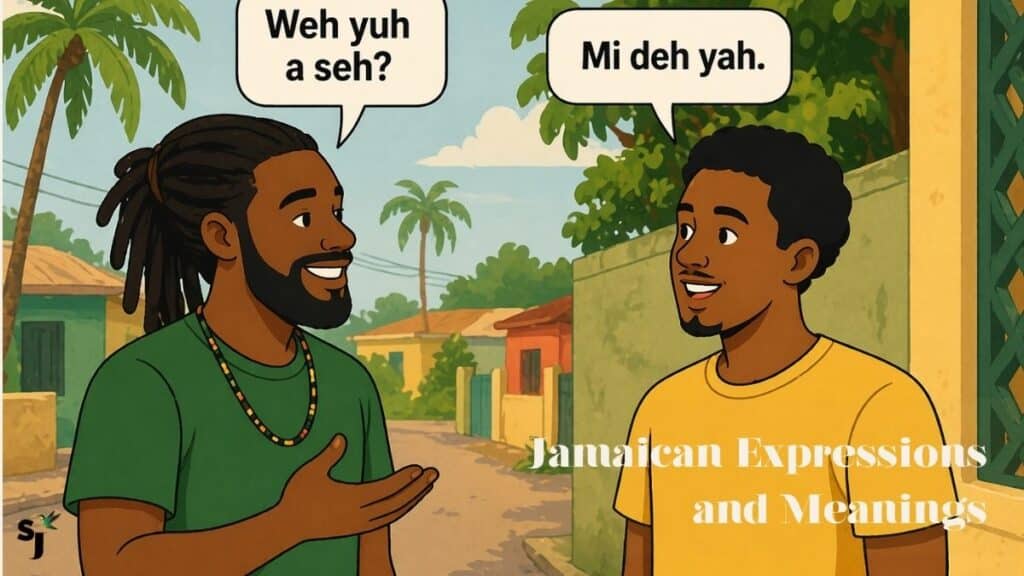
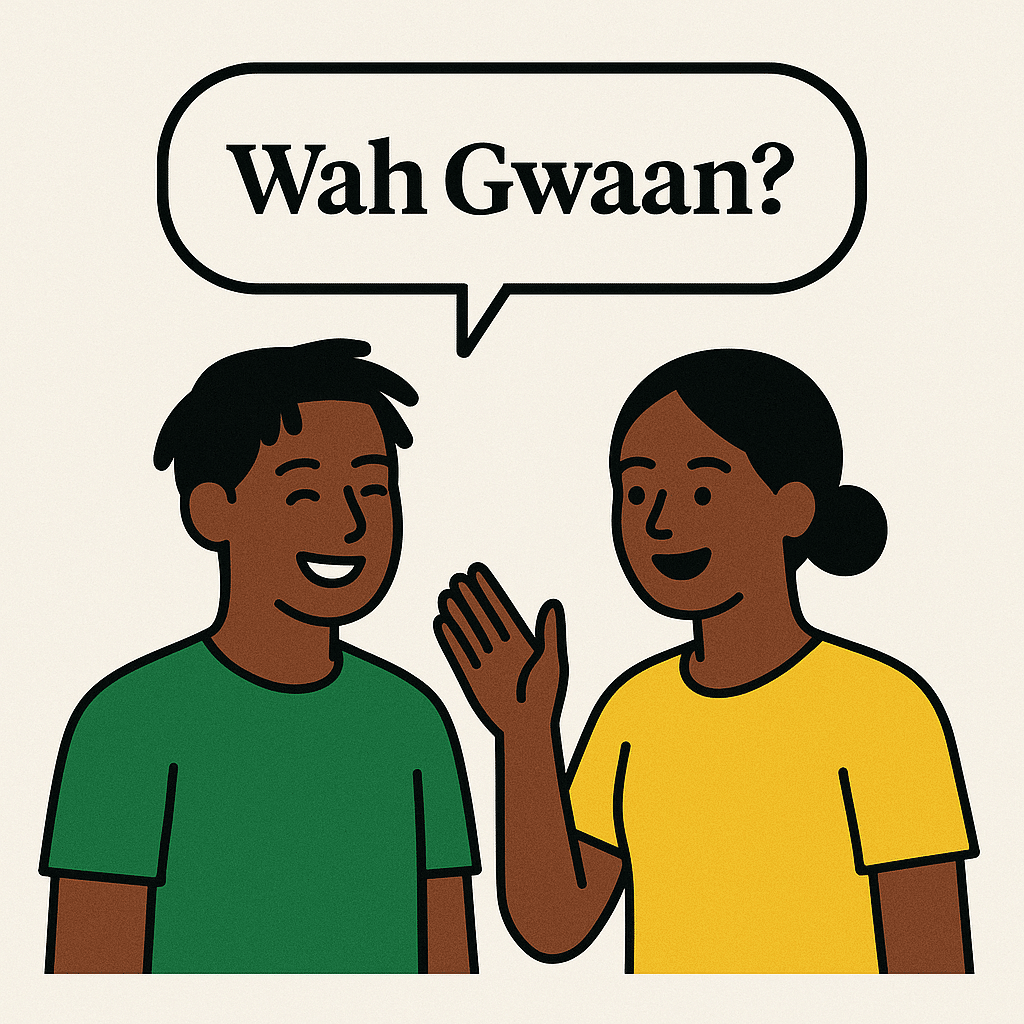
Wah gwaan?
Meaning: What’s going on? / What’s up?
Example: “Wah gwaan, mi bredda?”
Cultural Note: One of the most globally recognized Jamaican slang greetings, often met with “Mi deh yah.”
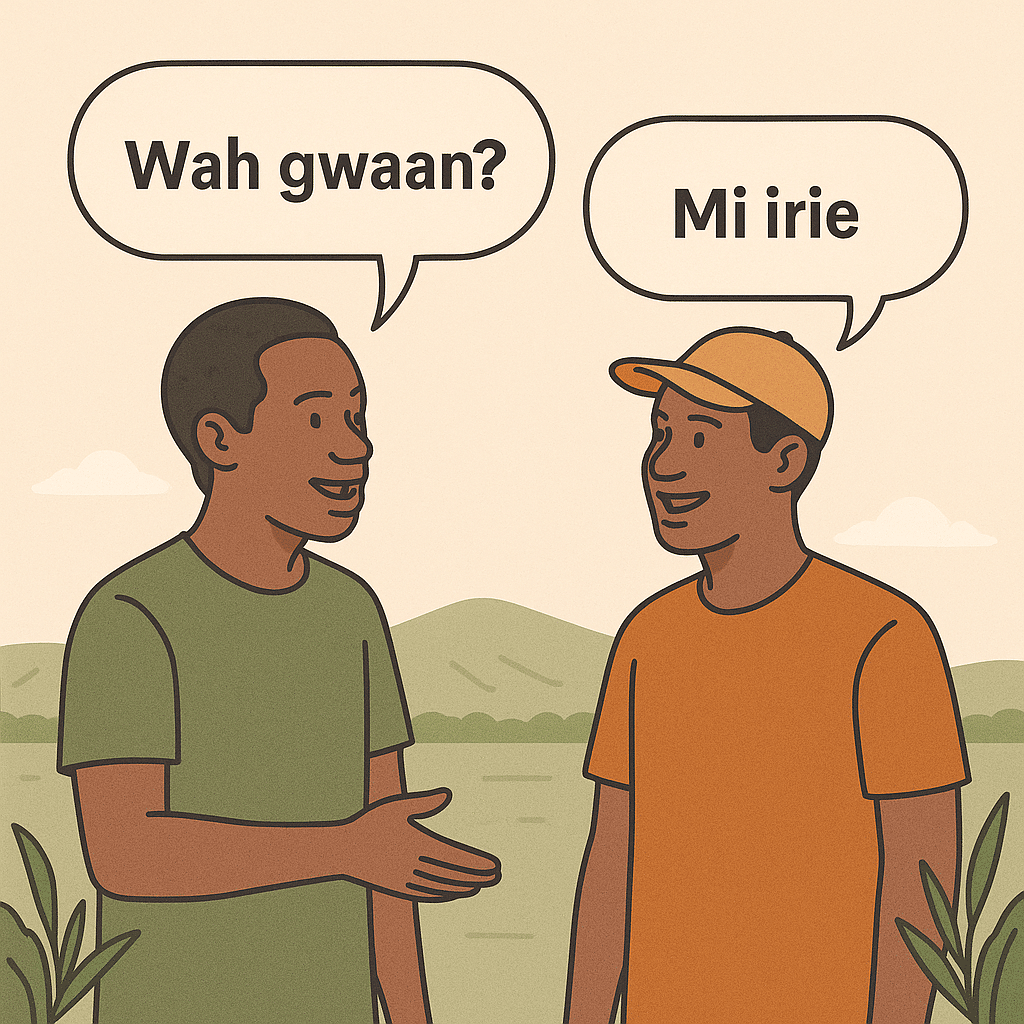
Irie
Meaning: Everything is good, alright, peaceful
Example: “How yuh feelin’?” — “Mi irie, man.”
Cultural Note: Rooted in Rastafarian culture, it expresses joy and spiritual balance.
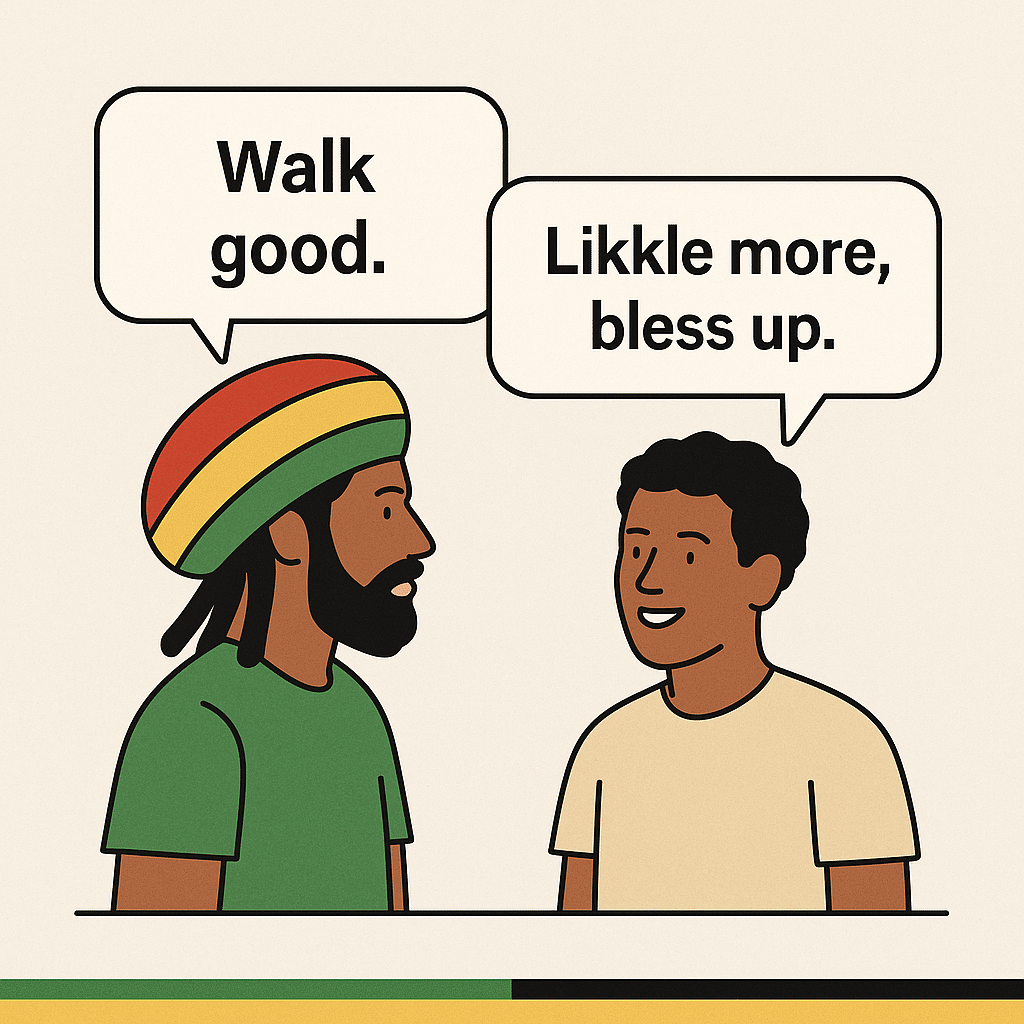
Walk good
Meaning: Take care / Safe journey
Example: “Later mi fren. Walk good.”
Cultural Note: A heartfelt goodbye that shows Jamaican warmth.
Hush
Meaning: Sorry / Expression of comfort
Example: “Hush, mi know yuh feel it.”
Cultural Note: Unlike in English, it’s not silencing—it’s compassion.
Mi deh yah
Meaning: I’m here / I’m doing okay
Example: “Wah gwaan?” — “Mi deh yah, yuh know.”
Cultural Note: The standard reply—humble, grounded, and uniquely Jamaican.
Yeah man
Meaning: Yes / No problem
Example: “Mi a link yuh later.” — “Yeah man.”
Cultural Note: A positive, reassuring affirmation that’s become iconic worldwide.
Likkle more
Meaning: See you later
Example: “Mi gone now, likkle more.”
Cultural Note: A casual, friendly farewell like “Catch you later.”
Bless up
Meaning: Stay well / Be blessed
Example: “Mi a cut now, bless up.”
Cultural Note: A respectful send-off that’s spiritual and uplifting.
Hype Expressions and Party Talk
Jamaican hype culture has its own vocabulary — built in the dancehall, refined on the street.
Tun up
Meaning: Lit, exciting, top-tier
Example: “Di party tun up last night!”
Cultural Note: From dancehall, describes high energy and excellence.
Mad ting
Meaning: Something wild, amazing, or outrageous
Example: “Yow, di moves dem was a mad ting!”
Cultural Note: Can mean crazy impressive or shockingly wild.
Big up
Meaning: Respect / Shout-out
Example: “Big up yuhself every time!”
Cultural Note: Popular in reggae and dancehall—means props and recognition.
Shell dung
Meaning: Dominate, mash up (an event)
Example: “Di artiste shell dung di stage!”
Cultural Note: Big praise in music culture—delivering a killer performance.
Run di place
Meaning: To dominate / Be in charge
Example: “She a run di place inna fashion.”
Cultural Note: High respect—used for leaders, trendsetters, or winners.
Dun know
Meaning: Of course / You already know
Example: “Mi have yuh back. Dun know!”
Cultural Note: A confident statement of loyalty or agreement.
Food and Everyday Life Slang
Some of the most expressive Jamaican slang lives around the table and the yard.
Brawta
Meaning: A little extra, often food or goods
Example: “Mi buy two dumplin an’ di lady gi mi brawta!”
Cultural Note: Reflects generosity—extra love from vendors.
Craven
Meaning: Greedy, especially with food
Example: “Yuh too craven, save some fi di rest a wi!”
Cultural Note: Said humorously at mealtime or teasing kids.
Nyam
Meaning: Eat
Example: “Mi hungry, mi need something fi nyam.”
Cultural Note: Widely used term, straight to the point.
Insults, Clashes, and Badwords
Jamaican language doesn’t shy away from the sharp end. Handle these with cultural awareness — and for the full history of the words that really carry weight, see Jamaican Badwords 101.
Bad like yaaaz (yaws)
Meaning: Extremely stylish, impressive, or dangerously good
Example: “Yuh see she outfit? She bad like yaaaz!”
Cultural Note: From yaws, a contagious disease—implies someone’s impact is infectious.
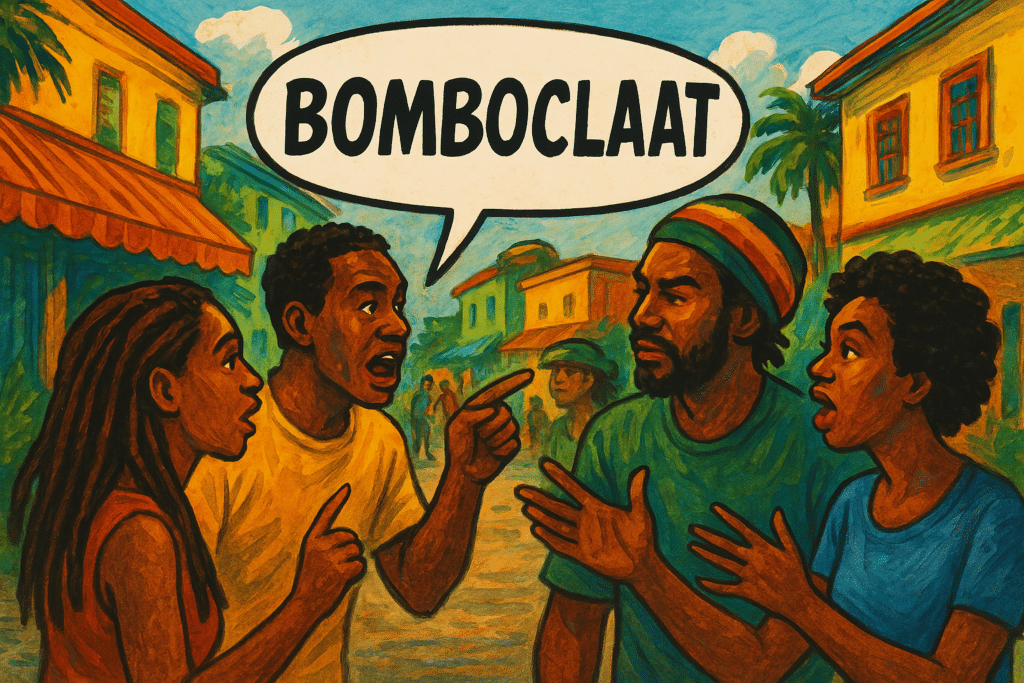
Claat (bumboclaat, rassclaat, etc.)
Meaning: Strong Jamaican expletive
Example: “Bumboclaat! Mi drop mi phone again.”
Cultural Note: Potent curse word rooted in “cloth.” Not polite, but very Jamaican.
Fassy
Meaning: Disrespectful, shady, or fake person
Example: “Mi nuh deal wid fassy people.”
Cultural Note: Popular in dancehall culture—calls out untrustworthy people.
Kaka faart
Meaning: A useless, annoying, or foolish person
Example: “Gweh from yah so, yuh a real kaka faart!”
Cultural Note: A crude but funny insult—emphasizing stink or foolishness.
Street Talk and Everyday Phrases
The everyday texture of Jamaican conversation — what gets said when people are just living their lives.
Nuh badda mi
Meaning: Leave me alone / Don’t bother me
Example: “Mi tired, nuh badda mi today.”
Tek weh yuhself
Meaning: Leave / Go away
Example: “Mi nuh inna di drama, tek weh yuhself.”
Mi soon come
Meaning: I’ll be back soon (not always literally soon)
Example: “Mi soon come, don’t move.”
Uzeeet?
Meaning: You get it? / Do you understand?
Example: “Mi nuh waan repeat miself again, uzeeet?”
Yute
Meaning: Young person / Youth
Example: “Di yute dem full a vibes.”
Zeen
Meaning: Okay / I understand
Example: “Wi a link later, zeen?”
A who dat?
Meaning: Who’s that?
Example: “A who dat pon di phone?”
Small up yuhself
Meaning: Make room / Squeeze in
Example: “Small up yuhself so mi can sit down.”
Deh pon
Meaning: On something / Busy with something
Example: “Mi deh pon di grind all week.”
Pree
Meaning: Watch / Observe closely
Example: “Mi a pree di man from long time.”
Lift up
Meaning: Leave / Move away
Example: “Lift up outta di yard, mi nuh inna it today.”
Talk Di Tings Dem
From ‘wah gwaan’ to ‘walk good’, Jamaican slang carries something that no dictionary entry can fully hold — the weight of a culture that has always known how to say more with less.
These 38 expressions are the starting point. The language goes much deeper. The slang leads to the Patois, the Patois leads to the history, and the history leads to understanding Jamaica in a way that goes well beyond any tourist experience.
Jamaican language is always evolving, and we know there are countless phrases out there beyond this glossary.
👉 Did we miss one of your favourite Jamaican expressions? Drop it in the comments below — and if you’re Jamaican, tell us the one every visitor always gets wrong.
Walk Good. 🇯🇲
Every Nook. Every Cranny. All Jamaican.